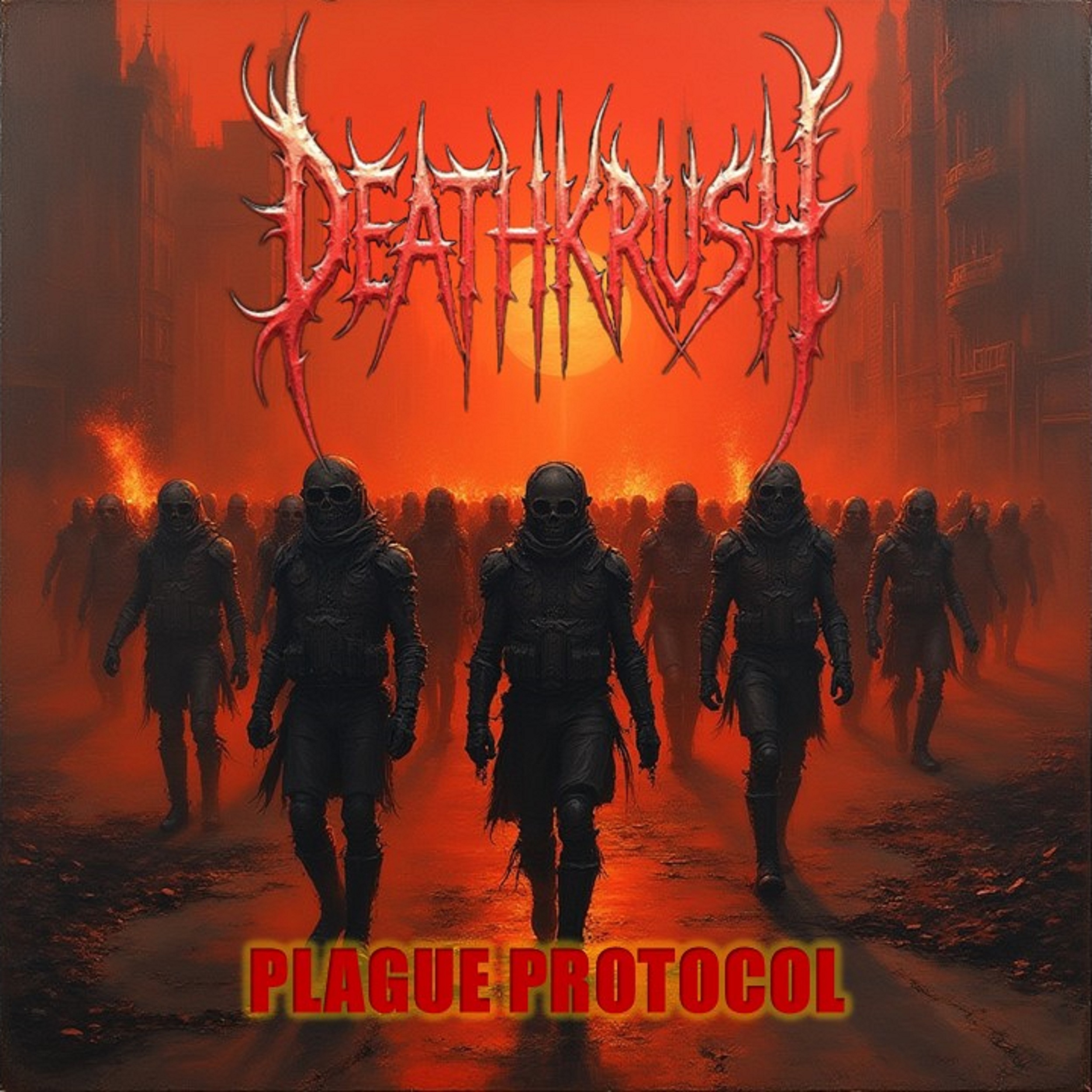
Deathkrush is a tribute to absolute extremity, born and honed in the darkness and tempered by a sense of absolute sonic violence. Coming from the underground scene, their music is a deadly mix of death metal violence and metalcore melodies. The overall effect is akin to a collapsed cathedral, huge, messy, and inescapable. “Deathkrush” revolves around a guitar sound that has been tuned to an art of terror, coupled with drums that provide a lesson in how to devastate with finesse. The blast beats follow at lightning speed, combined with some bone-jarringly heavy mid-tempo chugging that makes for an initial rush that puts you on edge between exiting on an adrenaline rush and something akin to terror. Their nine-song powerhouse of an album, “Plague Protocol,” arrived on December 26th. Let me break down the album for you.
The album opens with “Marching Into Hell”. When the song starts, the gates of the melody swing ajar with a kick. You hear motion before you hear music. The drums march with a military stare, the grinding guitars locked in a strict pattern, a mantra less and a command crudely spat. The vocals burst forth, introducing themselves? No way in hell, they command, commanding you to march. “Lyrically, this song is about intentional descent.” This song is not about a lack of awareness or a temptation that comes from within; it is about walking towards the destruction with one’s eyes wide open with courage. “Lyrically, this is about people who are aware of the cost but pay it anyway for reasons unknown. This is merely the momentum for the characters within the song. Musical components” remain linear with “no melodic resolution.” This is exactly what is being depicted within the song that one is swept along with the pace with the rhythm, wondering if they are leading or following by the time the song is finished.
At number two, we have the album’s namesake, “Plague Protocol”. The intro feels calculated, like a sheet of glass where the drum solo shatters. Guitars snap rather than roar, drums sounding precise and unforgiving, wild as the rhythm jumps right into your head and skin. The lyrics are a system speaking through a human mouth,” Stoff said in an interview, describing the way the words trace how disaster becomes policy, how suffering is managed and optimized after it is written into the rules of policy. This is a place where hope is a relic and a thing of the past, causing citizens to live in despair. “The lyrics are a system speaking through a human mouth,” Stoff said in an interview, describing the way the words trace how disaster becomes policy, how suffering is managed and optimized after it is written into the rules of policy.
The third song is called “Bleeding Oracle”. The song bursts open with a drum solo that will get you up on your feet, hooting and hollering for more. Then it is the turn of the guitars. The guitars in this case seem more acute and frenzied, as if the music itself is warning you of something, yet it can’t be comprehended. These guitars seem akin to those of a guitar god, playing them for themselves. The lyrics focus on truth through suffering: The oracle” is not intelligent or respected. It is hurt, disregarded, and taken advantage of. So the knowledge in the song costs blood, and even that is disregarded until it is too late. In this piece, the band inserts more and more chaos into the music. Abrupt tempo changes and harsh transitions make the music unpredictable and make the listener feel the anxiety of a warning that no one wants to hear, including the speaker of the lyrics.
The next song is called “Last Breath”. This song kicks off with space. Not silence, though; this is more like tension. The music seems as though it is being held back. When the full force hits, this is more intimate than epic. This introduction will put you in the right frame of mind for the song. “This song begins with space. Not silence, necessarily, but more tension. The music sounds as if it’s been restrained. When the full effect arrives, the result feels more personal than monumental. The opening will place you squarely in the mindset for this song. In terms of the music, there is rhythm, and the instrumentation permits the feeling to creep in, but heavier spots come crashing like a sense of inevitability. So come on rage with the band about deterioration.
Up next is “Ashes of the Crown”. The start of the riff and drum beat sounds royal in a battered manner, as if it’s a national anthem being performed on battered instruments. Some amount of grandness is evident in this, but it’s scorched. The rawness comes back once more, and you have to be prepared for what this song has in store for you. The lyrics are more about dissection after power. Not of the fall itself, but what’s left when authority collapses and nobody knows how to live without it. Honestly, we all despise anyone in power, but can we really look after ourselves when there happens to be nobody there to pick up the slack? The song actually suggests that crowns tend to burn hotter than they shine, while their ashes poison the ground. Musically, this is one of the album’s most layered tracks: guitars stack into dense harmonies while the rhythm section drives forward with grim confidence. The feeling it evokes in listeners is anger and mourning. You’re not celebrating the fall-you’re counting the cost.
“Extinction” is the next song on the record. There’s no hesitation in the introduction. This song comes off with the force of a guilty verdict being read from the courtroom steps, and the riffs are as vast as they are crushing; there’s nothing else in those moments, just the music pounding and you enjoying the ride. Just like the title says, this is about extinction – the end of all life. The finality of the message eschews metaphor and plunges headfirst into conclusion. This is no longer a warning. This is the outcome, where Humanity, morality, and meaning are merely footnotes in an equation that couldn’t possibly care. Repetition is a musical device that is used as a weapon here. The riffs go round and round in endless cycles, further enforcing the concept of inevitability. The effect that is created here is one of overwhelm, of numbness, which corresponds to the concept of erasure itself, and also reifies the concept of the
Next on the record is “The Collapse”. The song opens fractured, the Rhythms feel unstable, not quite predictable, like the music might fall apart mid-phrase. There’s a sense of structures failing in real time. This song can also have a metaphorical interpretation as well as a literal meaning. Speaking metaphorically, it might relate to the implosion that occurs inside us or inside our minds, as well as the literal breakdown that occurs inside our world, meaning the crumbling of our government or our citizens. This song, in terms of its lyrical meaning, explores the point when everything that the public trusted turned out to be empty. Not just our government, but our beliefs, our selves, our promises. There’s a tension in this music, a sort of push-and-pull between chaos and moments of control, and it’s very easy to feel as if you’re a part of it, as if this music is a sort of unraveling that you’re trying to keep from falling apart.
The second-to-last song is called “No Redemption”. When the rest of the band comes in, it’s heavy, not fast, and explosive. The primal scream is heard again, and this intro and song are made visceral and raw because of it. The lyrics do not contain forgiveness narratives,” writes Murray, quoting the lyrics in the song and stating that in this particular piece, it is clearly indicated that the character or characters are beyond forgiveness and redemption. In terms of musicianship, Deathkrush is more about heft than speed. Every impact is deliberate. Listening, though, this particular song encourages introspection. It is awkward, to the point of being accusatory, as if it is questioning what one has to be forgiven for.
The album curtain closes with “Final Curse”. The album ends with a slow intro that has a kind of ceremonial quality to it. It’s neither triumphant nor tragic. It simply marks the end. The song itself brings with it the weight of all the music that has led up to its realization. Lyrically, this is not a curse being spoken outward, but an acknowledgment being made inward. Metaphorically, this could mean that this character believes the end is falling apart around him, while, maybe, this curse is what broke the camel’s back. It shows that the most severe damnation is through the legacy. Cycles repeat, lessons not learned, endings rehearsed. Musically, the band allows the song to stretch and breathe, giving room for the album’s themes to settle in. The ending doesn’t resolve, and it goes out with a bang, like the way it started.
Enter the void with ‘Plague Protocol’, a death metal proclamation and the inaugural offering from Deathkrush, which foresees the next reckoning of humanity. ‘Plague Protocol’ is no mere set of songs; it is a prediction etched through unending blast beats and growling screams. Each song is akin to a sonic contagion, infecting people’s minds with a world whose future has been recomposed by a relentless epidemic. The music plays, and borders dissolve; governments collapse, the thin veneer of order crumbling into complete pandemonium. I have to say, this album made me tap into some of the most primal parts of myself, and I am done-meat-eager for what this dynamically talented band comes up with next.
Stream the “Plague Protocol” album on Spotify.
Subscribe to Deathkrush’s YouTube

- GALACTIC GENIUS: ZACHARY MASON DELIVERS AN OUT-OF-THIS-WORLD ROCK MASTERPIECE WITH “MAN OF THE UNIVERSE” - 23 September 2026
- BEYOND THE BATTLEFIELD: FOXY LEOPARD DELIVERS A BREATHTAKING SONIC TOUR DE FORCE WITH “CHILDREN OF THE WAR” - 23 September 2026
- CROWN OF HEAVY METAL BRILLIANCE: THE LAZZ UNLEASHES PSYCHOLOGICAL THUNDER ON “THE CROWN” - 23 September 2026