
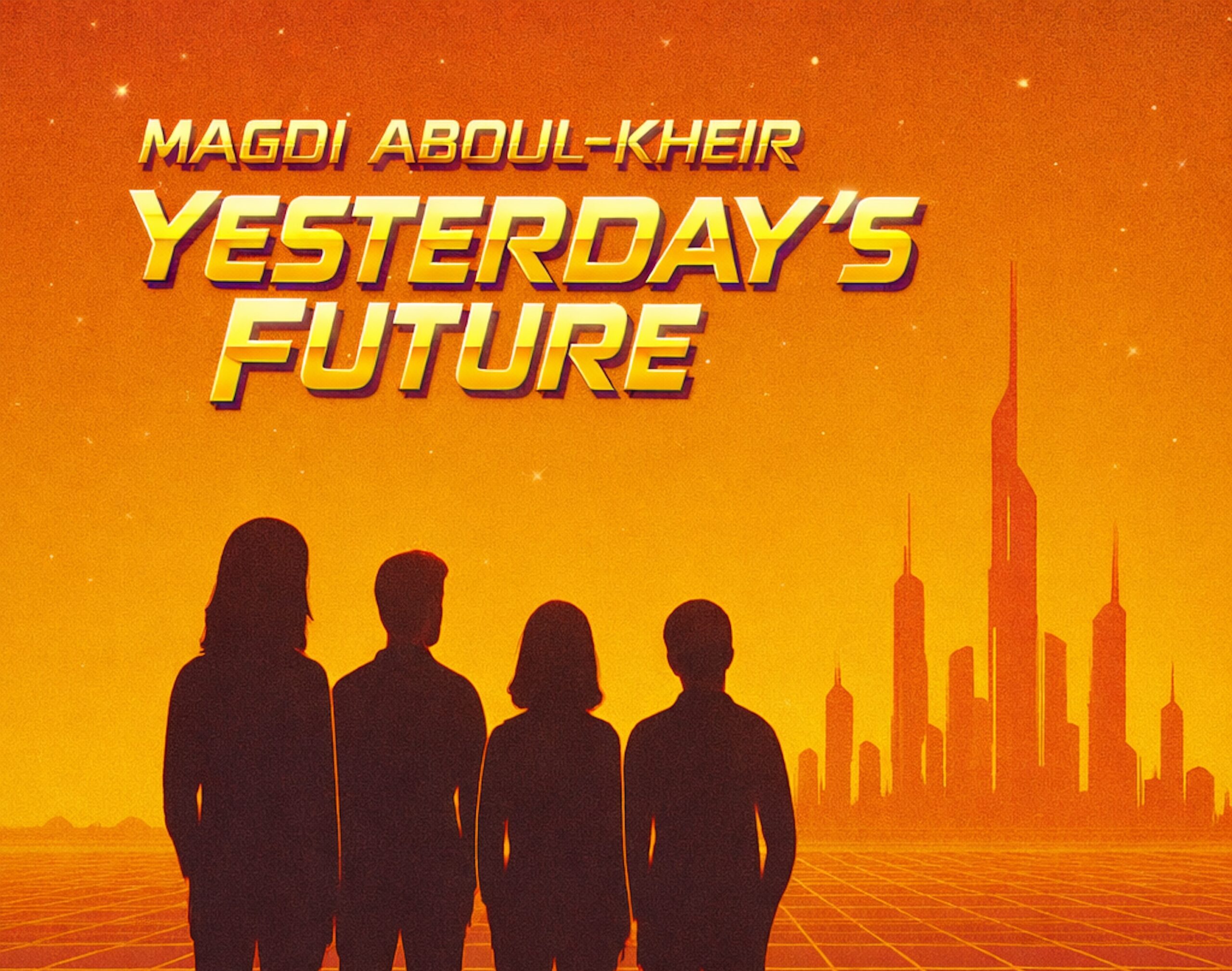
The release of “Yesterday’s Future” on July 31st represents another incredible addition to the ongoing world of Magdi Aboul-Kheir. Living in Germany, the artist continues to demonstrate that he is a true alchemist of sound by creating connections between the complex and intricate structures of the Baroque period and the aggressive power of heavy metal and electronic music. Seeing Aboul-Kheir play is like watching a musical shape-shifter who will not limit himself to one genre. Regardless of whether his music requires the delicately dignified atmosphere of a string quartet or the throbbing, brightly lit ambiance of a trance club, he controls the stage with complete mastery. Having emerged from a rich tradition of conventional piano education, he is more than just an ordinary musician; he is, in essence, a composer whose sole motivation in life is passion for melody, a true romantic. There is simply something truly amazing and mesmerizing in the way that he brings out the emotions, going from the rich and diverse palette of colors in a full orchestra symphony to the nostalgic vibes of the old synthesizer. After all, I have had a chance to watch and admire his work throughout all these milestones, from the gradual building up of intensity in “Slow Heat,” the complicated stories behind “The Weaving Of Human Nature,” the dreamy vibes of “The Piano Has Been Dreaming” and “One Last Dance”, and there could be nothing better for a devoted fan than to witness him present this magnificent collection of nine songs.
The trip begins with “Past is Calling”, with a shimmering, slow-buildup of ambient synthesizer pads that soon come together into a hypnotic beat. Even though it’s an instrumental, the sounds that speak to me seem to be saying that the theme of the song seems to be emotional connection to times past and a future not fulfilled, and an intellectual meditation on how previous decades envisioned the future. In terms of music, it uses amazing keyboard work and synthesis soundscapes to create an impression of timeless elegance without uttering a single word. It creates an incredibly immersive experience that acts as an open gateway to rethink hope and imagination. This is a side of this artist I’m yet to experience; it’s fresh and exciting, and it gets you warmed up for the rest of the album.
Boosting the energy to its maximum levels, “Machines’ Gym” begins with the sound of a dark and dramatic rhythm machine which clicks like a clockwork engine, leading up to an upbeat, lively bass line opening up the doors. The song involves humans’ interest in automatic vitality, kinetic energy, and the rhythm of industry within a retro future landscape because of the synths that are used in it. As far as musicality is concerned, the song succeeds in combining fun and catchy synthesizer rhythms and electronic melodies, making sure that the rhythm remains upbeat and dynamic all the time.
Taking the exhilaration to the next level with “Endorphine Wave”? The track kicks off with an abrupt surge of swirling and high-energy synthesizer waves that simulate the effect of a jolt of energy and then settles into a fast-paced rhythm. The concept behind the piece revolves around the joy of movement, freedom of emotions, and the ecstasy of musical euphoria at its best. Musically speaking, the instruments create a wall of sounds through sparkling arpeggios with a strong rhythmic base. He was right to name this song Endorphine Wave because it truly felt like I was swimming in a pool of endorphins, and it was a wonderful swim, let me tell you.
As one gets to delve deeper into the atmosphere of the music, “Through the Neonrain” opens with a haunting synth sound from the low end complemented with atmospheric sounds that create the feeling of a distant humming of a city at night soaked in water. The song’s vibes evoked the idea of loneliness, nighttime reflection, and the idealistic sadness in a city lit up by the glow of street lights. Musically, the piece contrasts the moody, sustained synths with bright and clear lead synths that cut through with emotion.
Venturing into the cosmos and its vast dimensions, “Pulsraum” begins with heavy echoes of ambient waves and a rare electronic heartbeat that gradually opens up to create an expansive sonic world. This song is very experimental and makes use of many other sounds apart from heavy bass synth pulses and waves. This is a different side of Aboul-Kheir that I am really enjoying. The melody in this song is achieved by the use of large synthesizer arrangements and evolving harmonies that take life in their organic nature.
Going straight to the heart of the issue, the title track “Yesterday’s Future” begins with a delightful chord progression on vintage keys that is followed by a rhythmic and optimistic groove that provides the framework for the melody. The vintage keys sound gives us a taste of his classical side again, but it’s paired with a completely fresh sound, and they mix quite beautifully. This song acts as the conceptual backbone of the whole album, which glorifies the optimism of the previous generations and the idealistic dreams they have for the future. As far as the musical aspects are concerned, the song combines beautiful string sounds with colorful synthesizers to create a masterful composition of nostalgia.
Descending into the shadowy depths, “Abyss of Shadows” begins with an ominous, growling sound from the synthesizer, which creates cinematic tension before sharp, metallic electronic beats begin to cut through the darkness. The sounds are dramatic and quite captivating, yet unlike anything you’ve ever heard. This piece of music poses a challenge – one of confronting the unknown, dealing with the fears within man, and the bravery needed to deal with darkness psychologically. Instrumentally, it becomes sharper and darker, with dissonant sounds from the synthesizer and pounding percussion, creating an air of suspense.
With explosive force, “Sunburst” begins with an intensely bright burst of rapid-fire tambourine-like, arpeggiated synth notes, immediately developing into an expansive, fast-paced soundscape. This motif is associated with renewal, breaking through obstacles, and the enlightening discovery that clarity comes after the storm. In the music, the composition includes intense guitar sections mixed with electronic leads along with a powerful drum machine beat. The listener is energized by a flood of inspiration.
Concluding this epic journey through music, “Life’s Journey” opens with a synth sound that gradually warms up into an atmospheric cushion of synths and strings. The rhythmic drumming is very satisfying to listen to. The song embodies the concept of time, the lessons learned from experience, and the serene acceptance of the twists and turns in one’s journey through life, just like the song, which changes even though the drum beat doesn’t. In terms of music, the theme serves as a demonstration of how to control dynamics in order to achieve catharsis. In the end, one is left with a feeling of closure in the face of the magnificent artistry one has experienced.
Then there are songs which serve as mere accompaniment, and then there are works which instantly take you to another dimension of sheer joy, and one such piece of work that comes to mind is MAGDI ABOUL-KHEIR’s “Yesterday’s Future,” which happens to be the quintessential example of the latter. This album is sheer fun, a triumphant, exhilarating DeLorean journey all the way back to the future; but not any future, rather the futuristic tomorrow of yesteryear when people used to imagine what tomorrow would be like. Nine superbly selected tracks, and Magdi Aboul-Kheir brings to life the legendary synth and drum machine music of the 1980s in an exhilarating new way. When you thought you were getting a handle on the soundscape, out comes the electric guitar, which soars right to the forefront, shredding along with an absolutely breathtaking string section that will blow you away. This kid truly made the lightning strike with this record, bottling up pure kinetic energy and showing that genius really cannot be confined within any box of genre. It’s an absolute joy to watch him break through every single barrier out there, and as someone who has been supporting his journey since day one, I am nothing but immensely proud and excited to experience this amazing journey with him!
Stream the “Yesterday’s Future” album on Spotify
Follow Magdi Aboul-Kheir on his socials: Facebook, Instagram, Bandcamp

- LIFTING AS WE CLIMB: WHY MICHAEL ALLEN’S LATEST SINGLE “COME ALONG FOR THE RIDE” IS THE MUSIC THE WORLD NEEDS RIGHT NOW - 25 September 2026
- PURE ANTHEMIC MAGIC: KELLY GRAHAM PROVES HE’S BORN FOR SUPERSTARDOM ON ‘RIDE WITH ME’ - 25 September 2026
- MASTERING THE CONTRAST: WHY WELTSCHMERZ ’S ‘REFUGIUM’ IS A MUST-LISTEN INSTRUMENTAL JOURNEY - 25 September 2026
