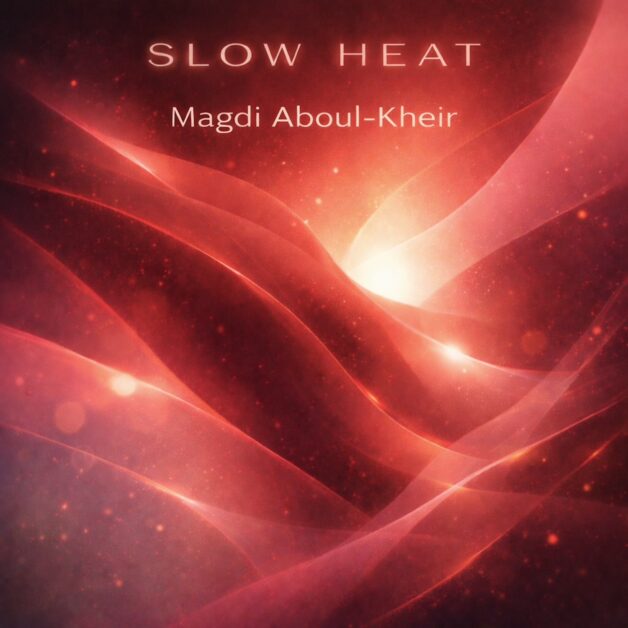
Germany-based composer and journalist Magdi Aboul-Kheir is a musical Renaissance man whose work is not bound by geography but by the expansive distance between the baroque and the raw power of metal, the seclusion of a string quartet, and the hypnotic beat of trance. A pianist by formal training, Aboul-Kheir is a composer at heart, guided as much by raw emotion as by skillful technique. A passionate believer in the power of melody, Aboul-Kheir is a composer whose music is as expressive as it is accessible, whether he is writing for the expansive scope of a full orchestra or the nostalgic warmth of retro synthesizers. It is my absolute pleasure to introduce you to the instrumental epic that is the ten-song odyssey that Magdi Aboul-Kheir unveiled on the 27th of February: “Slow Heat.”
The tracklisting begins with the title track, “Slow Heat,” which eschews any harsh percussion or immediate melodic content in favor of a gentle, breathing swell of sustained synthesizer sounds, akin to the first light of dawn breaking into a cold, dark room. There’s a clear sense of “gradual ignition” as slight changes in harmony begin to radiate outward, akin to the sensation of heat spreading through the body. In terms of musical content, there’s a gentle dialogue between electronic textures and more organic sounds, including a solo cello part that enters with a mournful but grounding effect. The result is a kind of total nervous system reboot, forcing the listener to slow their own heart rate to match the pace of the music, creating a space of absolute safety and focus.
“Pulse Language” starts with a more cerebral rhythmic energy and begins with dramatic, deep bass notes and panning synths, giving it a nocturnal, cinematic quality reminiscent of 80s film scores. It sounds like a mechanical heart starting to beat in an empty cathedral. The musicality is defined by its intricate layering of staccato synth stabs, shimmering synths, and lush orchestral arrangements, giving it a “cerebral dance.” For the listener, it is like eavesdropping on a personal, unspoken conversation that becomes more intense as the energy builds towards a sublime, panoramic finish.
Next is “Lunar/Solar,” which opens with a sudden plunge into a vast, cold sci-fi landscape, defined by deep oscillating electronic pulses and a high-pitched shimmering drone that evokes starlight. The scale of the instrumentation is vast and “vertical,” with deep sub-bass providing grounding and sparkling piano notes floating high in the mix. It’s like floating in zero-gravity, exploring the sonic dichotomy between the cold isolation of the Moon and the life-giving warmth of the Sun. The result is a deeply immersive sense of perspective, as if witnessing harmony in opposition from a great distance through shifting sound walls. This song would be perfect for the score of a sci-fi movie.
The song that follows is titled “Nectar. It begins with the soft and tactile sound of a treated flute playing a serpentine tune over a very faint static hiss. Musically speaking, the piece is more interested in blooming than in moving in a straight line. The cello and synth textures entwine each other in a sensual and liquid manner. The “vocal-like” nature of the woodwind instruments gives the piece a very human feel, as if the instruments are breathing beside you. The performance is one of concentrated sweetness, hitting the listener over the head with a bittersweet warmth that lingers long after the piece has ended.
“Ascending Flow” makes a shift to the majestic, ethereal, and slightly ominous with the introduction of heavy cascading chords on a grand piano that overlap one another to form a wall of Neoclassical music. It is as if one is entering a cavernous, ancient space in which every sound echoes. It is very musical and ritualistic with thick strings building in layers that give the sense of a literal ascent. It is the feeling of “heavy dread” turned into triumph and makes the listener feel the weight of the emotional ascent while providing a sense of gravity that finally bursts into light as the arrangement builds.
Next is “Inhaling You”, which is a return to a grounded, intimate level, and it begins with the bright, picked sound of a soft piano melody. The strings are then introduced, and they don’t overpower the piano melody at all. It’s sparse and vulnerable, with the natural resonance of the guitar and the soft piano playing the main roles. This song feels like a shared secret, recorded in a room where every movement is amplified. The result is one of great, quiet comfort, a musical hug that treats the ears well in return for a sense of closeness and atmosphere, almost as if it were just you and the artist performing.
“Below “Thoughts” enters with a low, dark, and dramatic hum and a series of “underwater” piano sounds, muffled and distant as if heard through a thick wall. Musically speaking, “Below” is a glacial pace with long decays and echoing guitars to create a moody and submerged soundscape. The instruments are more atmospheric and less melodic, focusing instead on the space between the sounds to create a state of deep contemplation and reflection. It puts the listener in a contemplative and almost hypnotic state, inviting one to dive into the quietest depths of the subconscious.
“Interweave” begins with multiple strands of a synth tone, a piano, and a soft percussive click, each starting at a different time and gradually coming together in a rhythm. The musicality is in the dialogue between the instruments, each imitating, responding to, and eventually coming together in one voice. It is a very technical, yet emotive, piece that demonstrates Aboul-Kheir’s skill in conducting a dialogue in sound alone. The result is a sense of unity and integration, as each voice eventually combines in one sound.
“One + One = One” begins with the soft cascading sounds of piano keys that evoke the image of running water, accompanied by the steady beat of electronic music. The musical style is contemplative and has a repetitive quality, charting a course towards natural serenity. The piano music is especially evocative, using the “white and black keys” as an allegory for the dance of dualities achieving complete balance. From the listener’s perspective, it is the emotional climax of the album, evoking the feeling of acceptance and beauty in complete surrender to the rhythm of the music.
“Skin Memory” closes the record with a classical piano piece that segues into a luscious cinematic strings piece, evoking the rhythm and feel of an elegant and ghostly waltz. The intro is hauntingly beautiful and has the feel of the score for a movie about lost time. The eventual build into the astral synthscape has the feel of a majestic release into the stars. The “vocal performance” is implied through the “crying” strings, which are imbued with a profound and beautiful sadness. The result is an emotional afterglow and a lingering sense of longing and peace, for reasons unknown.
Coming from the otherworldly realms of ambient music and grounded with the rich, earthy, organic rhythm, Slow Heat is an amazing tapestry that brings synthesizers and strings into the warm, personal sounds of the solo cello, the light woodwinds, and the acoustic guitar. Each song is its own vessel for the human touch, and the album plays not as a series of songs, but as a vast and flowing whole that rises and falls with the pace of breathless stillness and blazing light. Breathing, shimmering, and gently drifting through its own internal beat, it is an experience of soundscape so enveloping and warm that it is like an embrace; at its heart, it is a deeply moving exploration of the architecture of love. There is a certain kind of magic in instrumentals, a certain kind of depth that speaks to the soul in a way far more ancient and revealing than words can manage, and this is the very definition of it as a masterpiece. What a piece of art, what a masterpiece of an album, and what a great talent we are restlessly awaiting to take us somewhere next.
Stream the “Slow Heat” album on Spotify.
Follow Magdi Aboul-Kheir on his socials: Facebook, Instagram, Bandcamp

- THROUGH THE LENS OF A LIFETIME: PETE SCALES’ MASTERFUL AMERICANA ALBUM “BLUE WITHOUT YOU” - 11 March 2026
- ALGORITHMIC AWAKENING: BEYOND SIGNAL’S “GAIAALGORITHMICA” IS A SONIC MANIFESTO FOR THE DIGITAL SOUL - 11 March 2026
- THE ANALOG AWAKENING: “CHASING THE DRAGON” IS BRIAN BEE FRANK AND SYNDICATED MADNESS’ RAW ROCK REVOLUTION - 11 March 2026