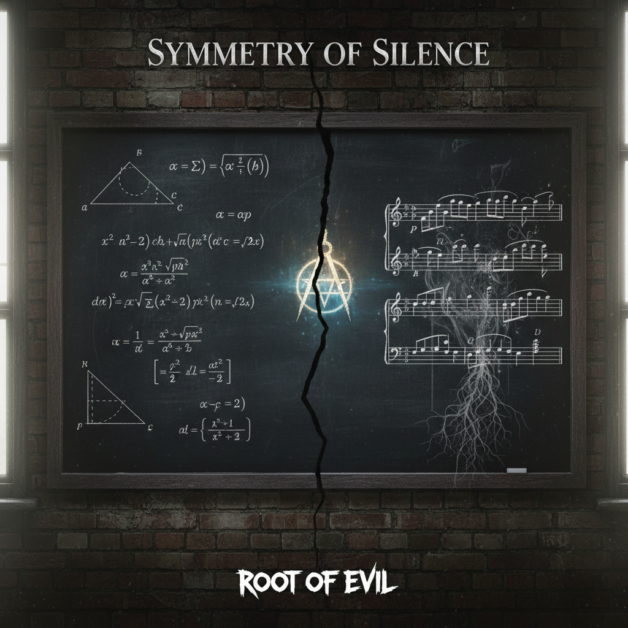
Emerging from the historic darkness of Villafranca di Verona, Root of Evil is more of a phenomenon than a band. It is an avant-garde experience that haunts and fascinates, existing at the sharp edge where cinematic majesty, industrial metal, and symphonic metal meet. The result is a soundscape that is akin to a broadcast from a post-apocalyptic future. At its essence, Root of Evil is a visceral journey through the conflict between the warmth of human blood and the cold calculation of artificial intelligence. It is a high-concept journey into a dark, dystopian world where every note is part of a larger, more visual story. On January 19th, they released their latest manifesto: Symmetry of Silence, a ten-track journey through the quiet topography of the soul. Let’s dive into the machine and examine this album track by track.
“Little Girl (Remastered)” is the first track on the album. The song emerges with delicate trickling piano sounds and caressing, writhing strings. It is almost like a soundtrack for a cold winter morning. There is also a lovely guitar strum in this one; rather, the “remastered” sheen enables the symphonic parts to stretch wide and airy before the electronic beat anchors it. This is a chilling encounter with the past. The lyrics address the tragedy of a self that has lost its way with its own past. It is about “times that will never return.” The character in the song remembers this little girl and the things he learned from her. Musically, listeners get a cinematic performance in which the artist leaves everything on the stage and bares his soul. The effect on the listener is one of deep, gnawing vulnerability, as the unadorned vocals soar skyward, bearing the weight of irreparable loss. This profound and majestic song opens this album.
At position two, we have “Shinedown (Remastered).” This track begins with a pulsing, mid-tempo electronic pattern with a digital heartbeat quality, soon accompanied by an industrial-rock guitar crunch. This is more “mechanical” than the first track, establishing an energetic rhythm right from the start. “Shinedown” is about the mask of genius. It is a struggle to keep the “shine” in a dystopian world. The character in the song seems successful or happy, but on the inside, they are hurting and having a very hard time because everything seems out of reach. The remastered track is all about the contrast between the cold digital patterns and the warmth of the guitars, leaving the listener invigorated yet also a little unsettled.
Next is the song “The Human Variable.” It opens with a soft piano melody, but then descends into a dark, sweeping orchestral gesture and a rhythmic, percussive ticking sound that borders on the countdown effect. Following the “liner notes” philosophy of the project, this track investigates the theme of the “human variable” as the thing that makes us human. It is about the resiliency of the human spirit: even though we fail again and again, we keep trying. Instead of seeing this repetition as a vicious cycle, it reclaims it as the unbreakable nature of humans. The music is thick and oppressive, as if the listener is caught in a system trying to quash individual emotion.
“Liar” is the next song on the record. This song features artist Axioma. “Liar” explodes with a hard, stuttering synth pattern and a bright, metallic guitar percussion attack. It doesn’t mess around; it’s an instant, high-energy industrial-metal attack featuring a breathtaking violin melody. This is a raw expression of anger at betrayal. The message is the “architecture of deception”, how deception is constructed like a building to conceal an empty center. Musically, they both sounded disappointed and hurt, which created a sense of tension and urgency in the song. The effect is a complete adrenaline rush. It’s the album’s expression of anger directed outwards, a strong contrast to the more internally focused symphonic songs.
“Dust in Memories” is the song that follows. At the beginning of this song, a hollow, reverberating ambient drone introduces the track, followed by a slow, ominous bassline. It’s like walking through a deserted building, where the atmosphere is full of “dust.” The track is a tribute to the things we forget. The lyrics revolve around the “decay of the digital age,” where even our recorded memories lose their significance. The music is dramatic and swelling, putting the listener in a state of suspended animation. It is a track that seems to dissolve as you listen.
Next is “Dust in Memories (Special Version)”. This version of the intro features glitchy and manipulated vocal clips and a stronger emphasis on the electronic “flicker” sound. Where the original version emphasizes the sadness of memory loss, the Special Version emphasizes the distortion of memory. It is implied that what we remember is a distorted file. This song features the beautiful voice of Axioma, and their voices blend as smoothly as butter. The impact is disorienting, as if the “symmetry” of the album is falling apart into digital static before reassembling itself into a melody.
“Silent Ink” is the next song on the record. It starts with a brief, distorted yet beautiful piano melody, but it builds into a haunting guitar melody processed with heavy delay. It’s “liquid,” as if the music itself is the ink. The theme is the power of the unsaid. “Silent Ink” is the words that are written in the mind that never get said with the tongue. It’s the hidden scripts of our lives. On the musical level, it is one of the most melodic tracks because it really showcases the artist’s powerful voice. It also features a symphonic landscape that feels like a rising tide, leaving the listener overwhelmed by the weight of the unsaid.
“Silent Ink (Special Version)”. This begins with very heavy industrial clanging and a much more aggressive rhythmic synth-bass, violin, and piano pattern. It eliminates the “liquid” feel in favor of something much more rigid and “iron-clad.” This version interprets the silence not as a decision but as an imposition. It is much more like being silenced by a machine. This song features Axioma yet again, but in this version, Root Of Evil sings in a much lower key than in the original version. Because of this, Axioma sings a higher key, and the Harmonizing is simply ethereal and unbelievably good! The musicality is much more aggressive and “cyber,” and the impact is one of resistance and struggle rather than the sadness of the original.
The next song is titled “Curriculum of Shadows.”A deep, piano-resonant cello or low-string section kicks off the song, soon followed by a slow, deliberate electric guitar strum and drum beat that sounds like a march. This is the “lesson” of the album. It’s about finding beauty in the darkness and learning the “curriculum” of one’s own shadow-self. This song also features Axioma, who gives a beautiful performance worthy of a standing ovation. It’s a song of dark, grim maturity and embracing oneself fully. The listener is led on a slow, dark journey that is clearly educational and transformative, as if the shadows are finally revealing their secrets.
The album ends with “Architect of Silence”. The album ends by removing everything, leaving only a melancholic piano that “trickles and glides” in the darkness. Axioma’s soft voice is introduced first, followed by Root of Evil’s powerful voice, forming a passionate and bare duet. This is the conclusion. The “Architect” is the individual who has finally learned to construct something beautiful out of the “silence” and “dust.” It is a reclaiming of control over one’s own story in a dystopian world. The effect is one of quiet, cinematic triumph. The listener is left in a position of “symmetry” and is full of gratitude toward someone who has helped them. I cannot forget to mention the Italiano that was sprinkled into the song towards the middle.
This album is a lesson in chaos theory, a ten-track journey that charts the subtle topography of the soul. By interweaving aggressive, primal riffs with orchestral richness and pulsing electronics, the project has established a connection between the natural and the artificial. To fully submerge, they have developed a 100% AI-driven visual identity, a bold digital reflection of the music’s intricate complexity. If you are looking for a sound that smashes the rules of contemporary Alternative Rock and Cinematic music, then this album is the destination. It is a rare, haunting work of art, a singular achievement in storytelling that has left me hungry for the next installment of their journey.
Stream the “Symmetry Of Silence” album on Spotify.
Follow Root of EVIL on Instagram
