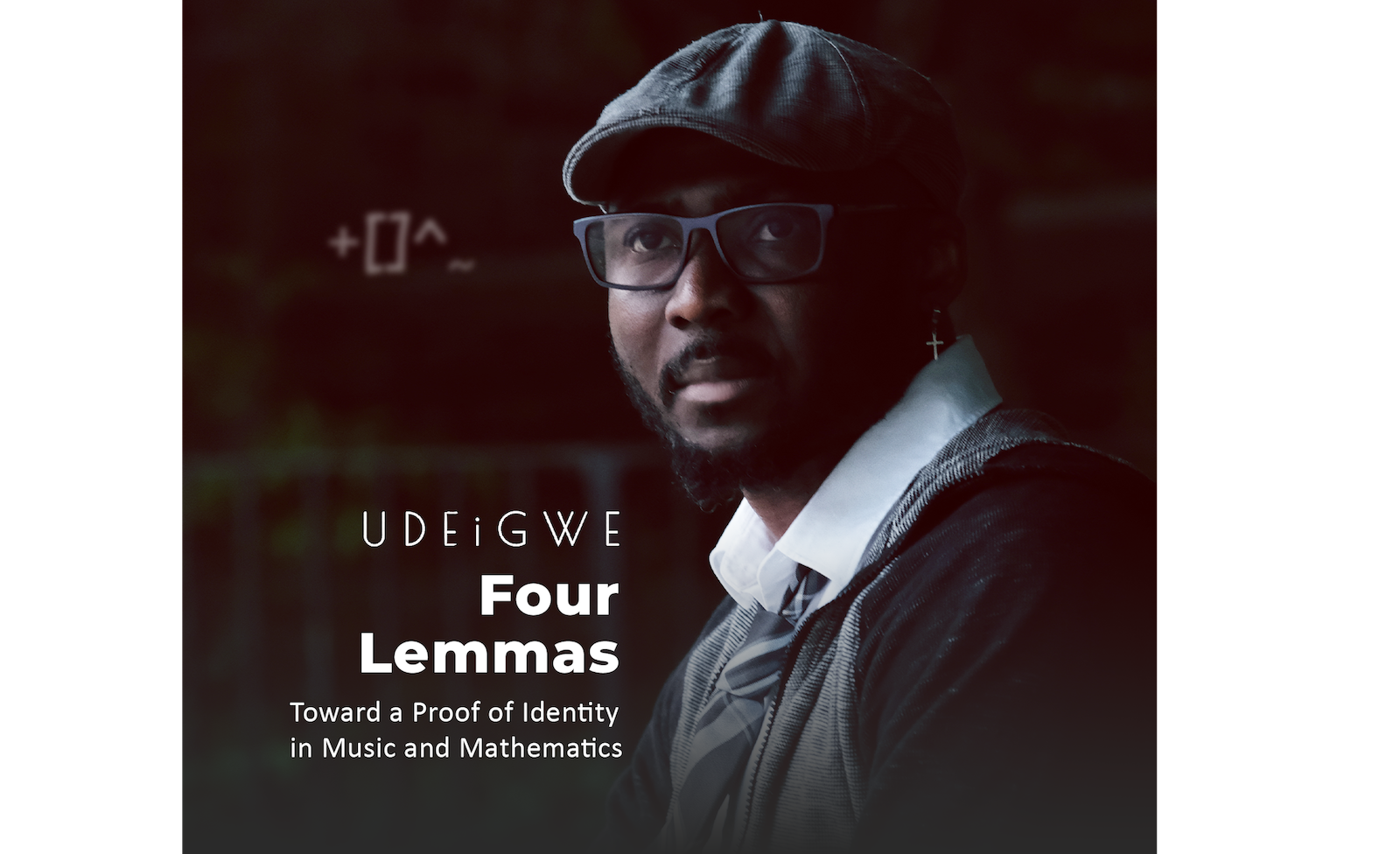
For one to fully grasp the genius of UDEiGWE (oo-DEE-gweh), one must realize that he is not only tuning in to listen to music but is entering the mind of a true polymath. A creation of the brilliant mind of Lawrence Udeigwe, the Nigerian-born, New Yorker-based artist exists in an intriguing and unique space where complex jazz music, mathematical prowess, and cognitive science intersect. Those lucky enough to have followed his journey in the world of art have known for a long time how impressive both intellectually and emotionally his work is due to the way he explores the effect of structure on thought. On May first, he bestowed on us the incredible eight-track concept album called The Four Lemmas, a true work of genius and a masterpiece in today’s music scene. It is an incredible manifestation of the creative theory that he espouses, transforming cold and hard analytic structures into a vibrant and passionate soul music that respects the deep traditions of rhythm and melody in his background but also pushes the envelope in the New York avant-garde scene. Allow us to delve into the pages of this musical journal and explore the composition of this truly amazing album.
This is not an opening statement, but an opening action. “Prologue: Four Lemmas” opens with a bouncy, energetic bassline paired with busy, complex percussion and unexpected, sharp horn hits interrupting the rhythmic flow. It creates a groove even before any words are spoken. It instantly tells us that this album is based on rhythm and its realities. The lyrical message is delivered right from the beginning: “Now I know my lines are drawn, and I see what’s meant for me. I can feel the proof is strong, building, binding, building, binding.” The concept itself is about self-actualization and discovering one’s identity, “proof of identity.” Udeigwe uses the mathematical term of lemma – a truth or axiom used in the proof of other theorems, to describe his own artistic development and evolution. Whoever said music and math don’t mix?. Musically, the song presents an impressive vocal display by Udeigwe, effortlessly switching from a smooth soulful singing style typical of alternative soul, through spoken-word poetry, to some scatting here and there. Instrumentally, the song feels like a dialogue in which the trumpets react to Udeigwe’s voice, moving between well-orchestrated horn phrases and free punctuations. As listeners, we are drawn into this world that makes mathematics feel natural. The song shows us that even though our adventure will be challenging, it remains human at heart.
“Lemmma I: Orthogonality” opens with a strong, clearly defined, and throbbing bass line, followed by an immediate rhythmic beat that maintains a lot of room between the beats. The intro lacks any cluttered chords and comes across as intentional and clear. Lyrics-wise, the song discusses the elegance of influence, but without falling apart. In particular, Udeigwe touches on an important topic of “independence without isolation.” The lyrics bring to attention the fact that sometimes two things or two people can be in the same place while remaining completely different and independent from each other, with an intersection occurring at a perfect right angle. Two things can be in perfect sync with each other but remain different because they have the same source of origin, which is what he emphasizes through his lyrics: “The zero between us is not emptiness / It is breathing room. A sacred distance that allows us to retain our wholeness.” The voice work by Udeigwe in this piece is very light and airy, and most importantly, very patient as it floats effortlessly over the rhythm section. As for the instrumentals in the composition, jazz minimalism is heavily employed in such a way that the upright bass becomes the backbone of the entire piece while the trumpet plays lengthy melodic lines that cut through space without overpowering the song. The effect on the listener is profound. It allows one to experience a sense of clarity emotionally through artistry.
In contrast to the reflective nature of the previous track, “Corollary I: I Don’t Care” comes with a burst of infectious and hard-hitting soul jazz vibes, featuring snapping snare drums and an almost immediately funky piano line that sets the scene straight from the beginning. While following on from the ideas presented in the first lemma, this time they revolve around an external, rather than internal, sense of independence. This is a song of liberation, where Udeigwe sings about breaking free of outside pressure, and in doing so uses regional African dialects in addition to English(pidgin) to convey the message. It is the freedom of realizing that you don’t have to care about the thoughts of other people, since all that matters is maintaining your own peace of mind. There is an amazing change in the vocal delivery, as Udeigwe changes his meditation-style speech delivery to a rugged yet rhythmic and soulful delivery, giving each note the feeling of being confident about celebration. There is no doubt about how vibrant the instrumentation becomes thanks to the use of powerful rhythms and strong horn lines played with the piano comping. There is a feel of lightness and excitement, as well as an invitation for the listener to dance out of their unnecessary worries.
Next is “Lemma II: Sparse Matrix,” which makes an entrance into the soundscape through a serene soundscape of keys and a deliberate, chanted-sounding lyricism that almost appears spiritual in its delivery. The composition comes off as spacious right away. The concept behind the composition is the idea of decluttering one’s mind in response to the cluttered nature of the digital world today. A sparse matrix is a term used in computer science that refers to a grid containing mostly zeroes. Through a poetic interpretation of the concept of sparse matrices, Udeigwe brings to life the idea of minimalism in a way that reduces nothing but adds no value. The lyrics describe the process through which our minds become crowded with junk data, superficial relationships, and negativity. The artist speaks about the strength of the word “no.” By deliberately forming “zeroes” in our lives, we end up filtering out what isn’t important and preserving the essence of ourselves. The vocal rendition is extremely personal and presented in an extremely intimate way through a soft, up-close, and poetic narration reminiscent of late-night talk between friends. The instrumentation fully reflects the song title by remaining extremely sparse, where the percussion uses soft rim shots, the bass is warm and solid, and the trumpet plays a distant and mournful melody. The effect on the listener is extremely soothing and healing. The song causes one to take an inventory of themselves and appreciate the simple things in life.
From the seamless transition from the sparsity of minimalism, “Corollary II: LU Principle” expands outward with its gorgeous, drumming and electronic flowing piano riffs that form a cycle. The piece gets its momentum quickly, as the swinging jazz cymbals keep on going and the smooth bassline comes in. This track has an intro that is very organized and methodical. With themes such as breakthroughs, personal methodologies, and style, “Corollary II: LU Principle” is the perfect example of such a song. When looking at the linear algebra formula for LU Decomposition, it is clear to see why Udeigwe used this analogy when referring to solving life’s biggest and most complicated crises. By looking at the lyrics, it becomes easy to see that it involves breaking down big life problems while maintaining your style. The voice performance by Udeigwe is quite impressive here, especially because he uses melodies to complement the chord progressions of his piano playing. The instrumental section demonstrates excellent dynamics in performance, whereby the rhythm section achieves a very smooth and sophisticated flow, and the trumpets perform impressively high, presenting powerful and victorious expressions. The effect on the listener is very motivating. It takes something that is very complicated and makes it catchy and inspiring enough to believe that personal development is achievable.
The song that follows is titled “Lemma III: Local Maximum”, which starts with an abrupt pause in rhythm, switching abruptly to a bold drum beat that is very captivating. This particular lemma is all about the idea of being cautious and not being fooled into thinking that a particular peak is the ultimate goal. In mathematics, a local maximum refers to the highest value in a restricted domain, but it is definitely not the highest value overall on the graph. It is brilliantly applied by Udeigwe in his interpretation of human desire for success and accomplishment, where he uses the lyrics to describe how easily people fall prey to the false belief that temporary success in terms of money, prestige, or work achievements can give us the satisfaction of reaching the pinnacle of our ambitions. Udeigwe’s vocals come across as extremely vulnerable and packed with emotional intensity. There is no excess use of instruments, which keeps the composition introspective and deeply philosophical in nature. The piano chords are dark but full, while the trumpet notes sound as if deliberately held back to symbolize self-restraint. The effect of the song on the listener can be described as sobering and philosophically enlightening. It forces the listeners to take stock of what they have done with their lives, asking whether they have merely reached a plateau and stopped developing.
Marking the transition from the heavy introspection that was experienced in the previous song, “Corollary III: Pose Fm “is immediately introduced by an upbeat and snappy guitar melody of African origin, and accompanied right away by vibrant and witty brass instrumentation that creates the ambiance of listening to a live broadcast on the radio. The theme focuses on creating humorous and witty social commentaries about various issues. This is a sarcastic commentary on the superficial “posing” that characterizes social media and society nowadays. By using sharp wit and witty lyrics, Udeigwe mocks the amount of effort people exert to appear to be perfect in life while forgetting that humans do not come out perfect at birth. This performance of vocals comes across as very lively and conversational, with some fun inflections as well as spoken word portions, along with an engaging feeling of sarcasm and irony. The instrumental aspect of this piece combines jazz brass and energetic African beats, all powered by an irresistibly fun guitar riff and energetic percussion. The effect is one of instant happiness and amusement for the listener, who is reminded not to be too self-serious about the act of living in such a performative society.
This album ends at “Lemma IV: Stable Equilibrium”, starting with a mesmerizing bassline, a strong and grounding drum beat, along with an ambient keyboard that sounds like a soft landing for the listeners. The idea behind this last piece of music represents the perfect manifestation of the entire concept of the album, a balance that cannot be achieved only through strict and rigid stability, but rather through constant movement and awareness. This is a contemplation about how one can find peace even amid the constant changes in life. “That’s what I need” becomes the phrase in this song that reflects the essence of the artist’s life philosophy and serves as the resolution of the identity proof. Udeigwe’s voice performance is particularly soulful and resonant in this song, creating an amazing performance that is soothing and highly expressive, giving a feeling of spiritual enlightenment. The instruments used here are extremely diverse but spacious, with trumpets producing some of the longest, most expressive tunes that eventually rise up above the trance-inducing rhythms. The result of this for the audience is a feeling of incredible resolution and calmness. It brings about complete clarity of thought, perfectly blending intellect and emotions in one piece of work.
The very moment of discovering the Four Lemmas by UDEiGWE is like seeing an artist at work at the very height of his abilities—it’s simply a wonderful thing, making you feel completely converted and eagerly waiting for what else he might come up with. This album is an outstanding and extremely unique creation of contemporary jazz, which brilliantly merges improvisation and spoken-word storytelling along with cinematic moods. Although the structure of the album is perfectly based on mathematical theory and proof logic, there is absolutely no rigidity in this music at all; on the contrary, UDEiGWE just uses this theory to reveal the most personal and human sides of individuality, independence, ambition, and the search for balance. Listening to this album is a spiritual transformation journey, for it easily touches that chord within us that hits right at the heart of African music, brimming with all the elements of real Afrobeat from another era. This album is so infused with the spirit of the people that it almost seems like it is pulsing within you, causing you to feel a surge of pure pride from the depths of your heart. Not only does UDEiGWE play music, but he also speaks through it in a way that is not only intellectually stimulating but also emotionally engaging. This album is not just a great record you listen to; this is a masterpiece that you experience through and through, marking an amazing new beginning in the world of music.
Stream “The Four Lemmas” album on Spotify
Follow Udeigwe here and his socials: X, Facebook, Instagram, YouTube

- KEESHA BLAIR’S “THE INHERITANCE” IS A TRIUMPH OF TIMELESS LEGACY AND SOUL-STIRRING ARTISTRY - 11 September 2026
- GUYVER7X3 CAPTIVATES WITH THE HAUNTINGLY VULNERABLE “HALF OF ME STILL WITH YOU” - 10 September 2026
- THE BASTAS PROJECT RETURNS TO CONQUER WITH THE TRIUMPHANT “HEAVY MACHINERY” - 10 September 2026