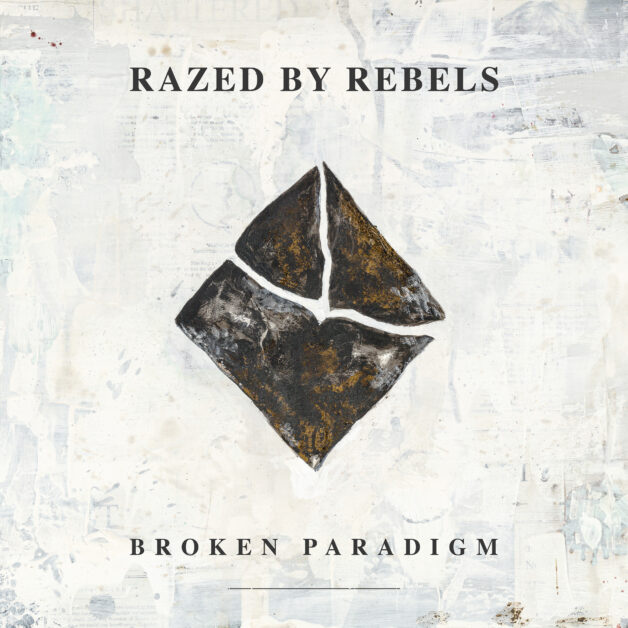
Born out of a lifelong obsession with sound and a hunger for collaborative alchemy, Razed by Rebels is not simply a musical entity but a sprawling industrial art rock project that combines storytelling with multimedia textures. With a healthy dose of Sci-Fi flair, this project has become a high-concept world-building exercise. On November 15th, the latest in their sonic architecture has been revealed to the world. Broken Paradigm, a nine-song odyssey, is a work that feels less like a track list and more like a journey into a beautifully fractured future. Let’s take a look at the gears and ghosts behind this phenomenal work.
“Until it’s over” doesn’t actually begin with a tune, but rather with a low-pitched, pulsing rhythm that feels like machinery coming to life in a dark room. The song, which features Hope Irish, has pulsing builds for several measures before a sharp, distorted synth riff slices through the air, creating a sense of immediate urgency. The subject matter is the unrelenting nature of survival, that particular human instinct to keep moving forward even when the finish line appears to be moving further and further away. The lyrics paint a picture of a world filled with “fading echoes” and “shadows that won’t stay still,” as if the subject is fighting a battle he may well lose, but fighting it anyway because the alternative is unthinkable. This character lets us know that his silence was not apathy; it was him bidding his time, and now that he’s ready, he has nothing to lose and is going to fight till his last breath. Musically, the vocal performance is strained and gritty, utilizing the full range of the vocalist to convey a sense of exhaustion. The instrumentation is a thick layering of industrial percussion elements and “dirty” synthesizers to provide a constant sense of momentum. For the listener, there’s a rush of adrenaline combined with a strange sense of solace. This song is an anthem for everyone who has ever felt like they were running out of time, but found a way to take one more step.
“The nobodies,” which features Alva Sim, opens with a soft piano melody before going into a sharp, syncopated electronic rhythm, with a dry snare sound that’s clinical and isolated, before a heavy, fuzz-laden bass drops in to give the track some grounding. This is a song that examines the invisible nature of the marginalized in our hyper-connected world, and it’s one that looks at the “ghosts in the machine” that power our society but are never seen. This song reveals a harsh truth that, most times, we don’t get the flowers or recognition we need when we’re alive, but as soon as we’re dead, then everyone says sweet things and finally pays us attention. I hope that through this song, we will get the flowers that we deserve while we’re alive. The musicality is surprisingly melodic, with a clean, almost melancholic vocal performance that bursts into a harmonized, soaring chorus. The juxtaposition of the cold, mechanical beat of the drums and the warmth of the vocal harmonies creates a sense of tension that perfectly encapsulates the idea of human emotion locked into a digital box. This is a song that listeners find haunting, as it makes us face the parts of ourselves that we try to hide just to fit into a system that does not actually care about us.
Next is “Beware the hunters,” which starts with a cinematic, sweeping drone, an eerie, high-pitched digital whine that is reminiscent of wind whistling through a hollowed-out city, something that sounds like taking in sharp, deep breaths, followed by a sudden, aggressive, and distorted guitar section. This is a song about paranoia and the predatory nature of modern surveillance, a character that is announcing his capabilities of hunting people down, with lyrics that speak of “eyes that never blink” and “predators wearing smiles,” and an instrumentation that is aggressive and jagged, with a drum section that hits with a violent, metallic “clack.” The vocals are a masterclass in controlled aggression, from a low, threatening whisper to a full-throated roar that demands your attention. It’s a visceral experience, one that leaves you feeling like you’re being watched, with a level of immersion that’s reminiscent of an experience, rather than something you’re simply passively listening to.
The album “Shattered Eyes” begins with a lonely, echoing piano tune that sounds slightly out of tune, like it’s being played on a forgotten instrument in a huge, empty room. There is a lot of “room sound” in this piece, giving it a somewhat hollow, mournful feel before the electronic elements begin to build up. We meet a character who seems to be a product of failed systems, sending a clear-cut warning to their leaders that he is taking over and he is going to save people who have been enslaved. The lyrics are poetic and broken, reflecting a shattered psyche that is trying to put itself back together again. The song itself is a slow burner, with shaky vocals that reflect a human fragility that contrasts sharply with the usual wall of sound that the band is known for. The instrumentation builds up to a chaotic, distorted crescendo that sounds like a mental breakdown, but it’s also deeply emotional and relatable, giving the listener a chance to reflect on their own moments of shattered perception without feeling like they have to “fix” them right away.
“A Way Through” starts with a dark and dramatic synth sound with a rhythm similar to that of rain on a metal roof, which is quickly joined by a soft piano melody that provides a ray of hope in a major key. This is the “light at the end of the tunnel” song for the album, and it’s about the “way through” that comes when you stop fighting and start working towards a solution. The lyrics are empowering and talk about “cracking the code” and “finding the seam” in a wall of sound. The musicality is fast and wide-ranging, with a vocal performance that is powerful and confident and ditches the grit for a clear and resonant sound. The instrumentation is layered with “sparkling” synth sounds that give the song a sense of space and airiness. To the listener, this song is a much-needed emotional release and a reminder that no paradigm is so broken that it can’t be navigated.
“Hiding Within” starts with a bass line that is filtered so low, it is akin to hearing it from behind a thick wall, but gradually opens up and becomes clear again as the high end is reintroduced. This is a song about the “safe rooms” inside of us, about the places in our mind where we go to escape a world that is getting too loud. It is an exploration of the thin line between self-preservation and complete self-isolation, and it is delivered in an intimate style, with the vocals recorded very close to the mic so you can practically hear the breath between words, so it feels like you’re being told a secret. It is a sparse sound, with deep sub-bass tones and light, glitchy electronic elements that pulse with a slow heartbeat, and it is an introspective sound, so it is the most “internal” part of this record.
“Together We’ve Lost,” which features Alexandra Ayoob, starts with a dual vocal harmony of a high and a low voice that sing a wordless melody that sounds like a contemporary funeral dirge, and then a mid-tempo drum beat starts. The theme of the song is the tragedy of shared failure and the moment when two people or a whole society realize that they have been walking in the wrong direction together. It is a song about the shared grief that happens with a “broken paradigm.” The musical style is a dark gothic rock sound with prominent strummed acoustic guitars and heavy industrial synth sounds. The vocal style is a tired and heavy-hearted sound that expresses a sense of disappointment and grief. The effect for the listener is a sense of shared empathy and validation that they are part of a “sinking ship” and a space to acknowledge the loss without having to put on a face that everything is okay.
The second-to-last song, “Directive #1,” breaks the somber mood set by the previous piece with its hard, rhythmic, and industrial thud, akin to the slamming of a heavy metal door, accompanied by a distorted robot voice-over that sounds like an actual emergency announcement. The piece is an exploration of authoritarianism and the loss of autonomy. The lyrics are cold and dictatorial, using the vocabulary of “compliance” and “standardization” to comment on the loss of individuality. The musicality is highly rhythmic and “militaristic” with the percussion moving in rigid, unchanging patterns that feel deliberately oppressive. The vocal work is highly distorted, giving the impression that the singer is part of the machine they are commenting on. The overall effect is jarring and unpleasant, intended to stir the spirit of rebellion in the listener because the “order” sounds so wrong.
“Heaven’s Gate” is a final track that closes out this album with a lengthy, swelling ambient drone sound that begins from almost inaudibility and gradually increases in volume over a full minute of time, finally meeting a clean, bell-like sound from a guitar pluck. This final track is about the search for ultimate peace or a complete exit from the cycles of the “broken paradigm.” This is a theme of transition and finality, leaving it unclear if this “gate” is a new beginning or an ultimate ending. It is very cinematic and expansive in its musicality, with a vocal performance that is ethereal and “long-form,” sustaining notes over an incredible length of time to evoke a timeless quality. It is joined by a massive orchestral sound of instrumentation that suddenly terminates in complete silence at its peak. It is a powerful and atmospheric piece, leaving one in a stunned silence, a silence that is a reminder of a journey that one must sit with in its completion.
It’s an album dripping with narrative significance, a sweeping epic set against a backdrop of systemic conflict that feels both historic and eerily present. It’s a tale of a protagonist’s journey as he’s forced to deconstruct his own beliefs, a journey through the rough landscape where idealism meets its ultimate, tragic consequence. This album is a masterclass in yin and yang: an album which is frenetic and urgent, but which often takes a moment to catch its breath in moments of shimmering melodic beauty. This is an album that demands you commit wholeheartedly to its sheer level of volume, a wild and untamed ride that I found myself completely immersed in. I implore you: take a leap of faith into the deep waters of storytelling contained within, an album which will linger long after the final notes have faded away, an experience which you will assuredly never regret.
Stream the “Broken Paradigm” album on Spotify.
Follow Razed by Rebels here and their socials: X, Facebook, Instagram, YouTube
