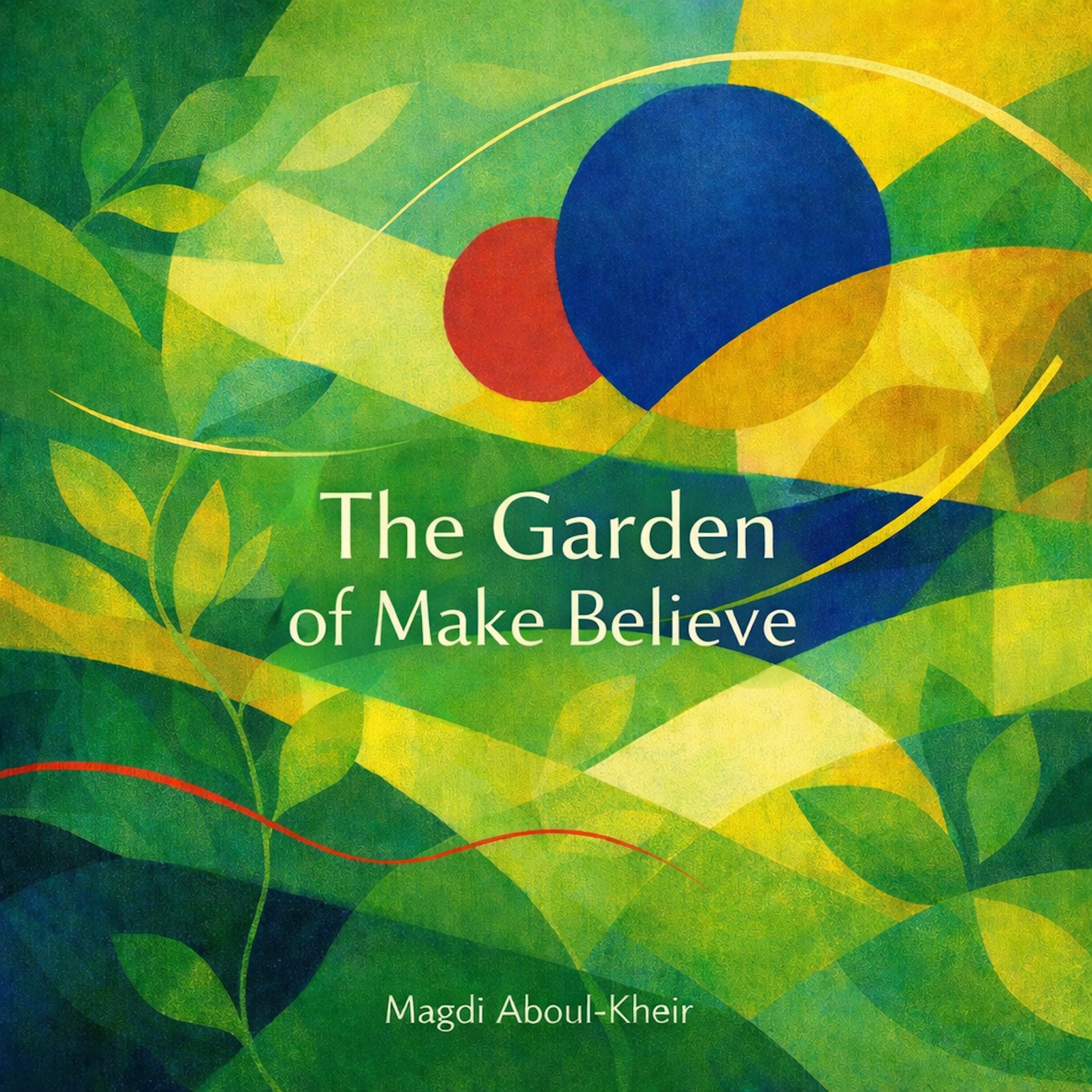
It is always a great pleasure to once again introduce our readership to Magdi Aboul-Kheir, a talented composer and writer from Germany, whose works are not just pieces of music but an embodiment of the very soul of music. This individual creates masterpieces within the uncharted territory that lies somewhere between the strict structure of Baroque and the wild nature of Metal music. It is a rare talent to produce music that remains equally alive both when reduced to the form of a quartet and when placed in a trance atmosphere. After the enchanting musical journeys found in Slow Heat, the artistic excellence of The Weaving Of Human Nature, and the surreal beauty of The Piano Has Been Dreaming, Magdi has once again graced us with an incredible work of art. On May 8th, the artist released his latest album entitled The Garden Of Make Believe, a ten-track experience in which reality loses its sharpness. Not only is it necessary for us to hear this album, but we must immerse ourselves in the atmosphere he has created.
It all starts with “On the meadow,” which eschews the clichéd use of flutes or birds chirping commonly associated with the theme of “pastoral.” Rather, this piece starts off with a subtle yet rhythmic beat from the muffled piano keys, giving an impression of a strong heart beating. With the gradual introduction of further instruments into the song, we are able to hear the harmonious combination of cello melodies along with soothing sounds made by the synth pads, giving us an impression of vast empty spaces. Musicality is very much present in this piece despite the lack of any vocal singing. This peaceful and calming song starts off the album beautifully
In “If I Could Freeze Time”, where the intro itself seems quite percussive, with a tick-tock-like rhythm made by gentle tapping on the piano. The song does not seem rushed; rather, there is a pause on certain chords, almost as though the song wants to capture that feeling of time freezing as suggested by its title. The layers of the instrumentation are quite complex, yet at the same time very clear, so much so that one can actually hear the movement of fingers along the keys, creating an effect on listeners that seems like there are having a private and intimate concert with the artist.
“Love in an Alternate Universe” is different from the organically arranged sounds heard before in the preceding songs. The song begins with a sound that starts low violin melody, before ascending to create a series of bright, and lively violin melody. The music turns out to be cinematic in nature and more orchestral as compared to the organic sounds seen before. In absence of lyrics in the song, the musical effect becomes one where there is a “call and response” between the breathtaking violin melody.
The mood becomes a lot more down-to-earth with “The world in his arms”. This track begins with a very low violin tone that is sustained for several seconds before giving way to a lighter melody It’s an extremely soothing song; the lower pitched instruments feature heavily in the song, creating a “heavier” but comforting effect. The music isn’t as elaborate as before, and the focus seems to be more on the wooden resonance of the violin strings.
The beginning of the song “Gentle ties” features an initial quiet sound made by the pressing down of a piano pedal, which is deliberate use of the so-called “lo-fi effect,” followed by a series of mid-tone chord progressions. The idea behind the song is that of connectivity, which comes to light in the music due to overlapping of the tunes played. A violin joins the performance in the middle of the song not to become the lead instrument but to join the tune of the piano. This song was exactly what you think it is and the title also tells you everything you need to know about it. It was gentle indeed and it was definitely worth my time and worth listening to
In the case of “Tears and Smiles”, the introduction is characterized by a dramatic juxtaposition between the use of staccato high tones and low, flowing minor chords. This creates an instant mood contrast that immediately establishes the context for the piece. The instrumentals are extremely varied, ranging from very soft sounds, which seem to dissolve into nothingness, to powerful major chord sounds. The use of frequencies at different levels mirrors the highs and lows of life discussed in the title.
Unlike the previous songs, “The Summer Wind in the Wheat” does not have any actual sounds of the wind. Instead, the song starts with a series of rapid vibrations played on a mandolin and a slow synth sounds. The use of various types of strings produces an illusion of motion. Unlike the other songs, where the music is soft and calm, in “The Summer Wind in the Wheat” the music is lively and vigorous, as if some kind of invisible force drives its sharp and urgent pace.
As the album’s title track, “The garden of make believe” acts as its emotional centerpiece. Its composition opens with reverb-laden piano that creates a feeling of melting notes into each other. There is something surreal about it. The orchestration is the most elaborate on this song; it features some delicate rises and falls from the orchestra, as well as a solid violin sound in the background, almost as an atmospheric touch without lyrics or melody.
My yearning and longing” is the next song on the album. The song starts with a solo oboe theme, accompanied by the melancholic sounds of the piano. The musicality of the song is largely focused on space, in which pauses in the music hold equal importance as the melodies. This creates a feeling of discovery. There is a significant reduction in the instrumentation of the song, with the song relying heavily on the vocal nature of the woodwind instrument.
It ends with “Sleepletter”, a track that begins with a gentle, rhythmic hissing sound – akin to the popping of an old vinyl recording or a slight rain shower. It is followed by a slow lullaby-like tune from either the celesta or piano instrument. This track uses “reductive” instrumentation, whereby instead of layering additional instruments, existing sounds progressively fade out. This means that by the conclusion of the track, only the original hissing rhythm remains.
It is quite impressive to see how well Magdi Aboul-Kheir continues to improve with each album, as the emotional depth he achieves with his music proves that “good music” is so much more than just a catchy melody. Instrumental music has a particular form of magic to it which doesn’t require the use of language to deliver a message, music touches the soul directly by connecting emotionally to it. The emotions expressed through music create a unique form of communication where even talking may be too limiting to describe. Being able to experience an artist like him is always an absolute pleasure. Congrats to Kheir on the new album and the amazing music experience it delivers.
Stream “The Garden Of Make Believe” album on Spotify
Follow Magdi Aboul-Kheir on his socials: Facebook, Instagram, Bandcamp

- “WASTED TEARS”: RICHARD GREEN DELIVERS AN UNTOUCHABLE INDIE-ELECTRONIC MASTERPIECE - 21 October 2026
- PRESS ON TO PROGRESS: HOW KAHMENCENTS AND CAZPERRBEATS TURNED LIFE’S WEIGHT INTO AN UNSTOPPABLE MOTIVATIONAL ANTHEM “PRESS SURE” - 21 October 2026
- WAKING UP TO GREATNESS: WHY JAMIE’S ELECTRIFYING NEW SINGLE “WAKING UP”,IS A POP-EDM MASTERPIECE - 21 October 2026