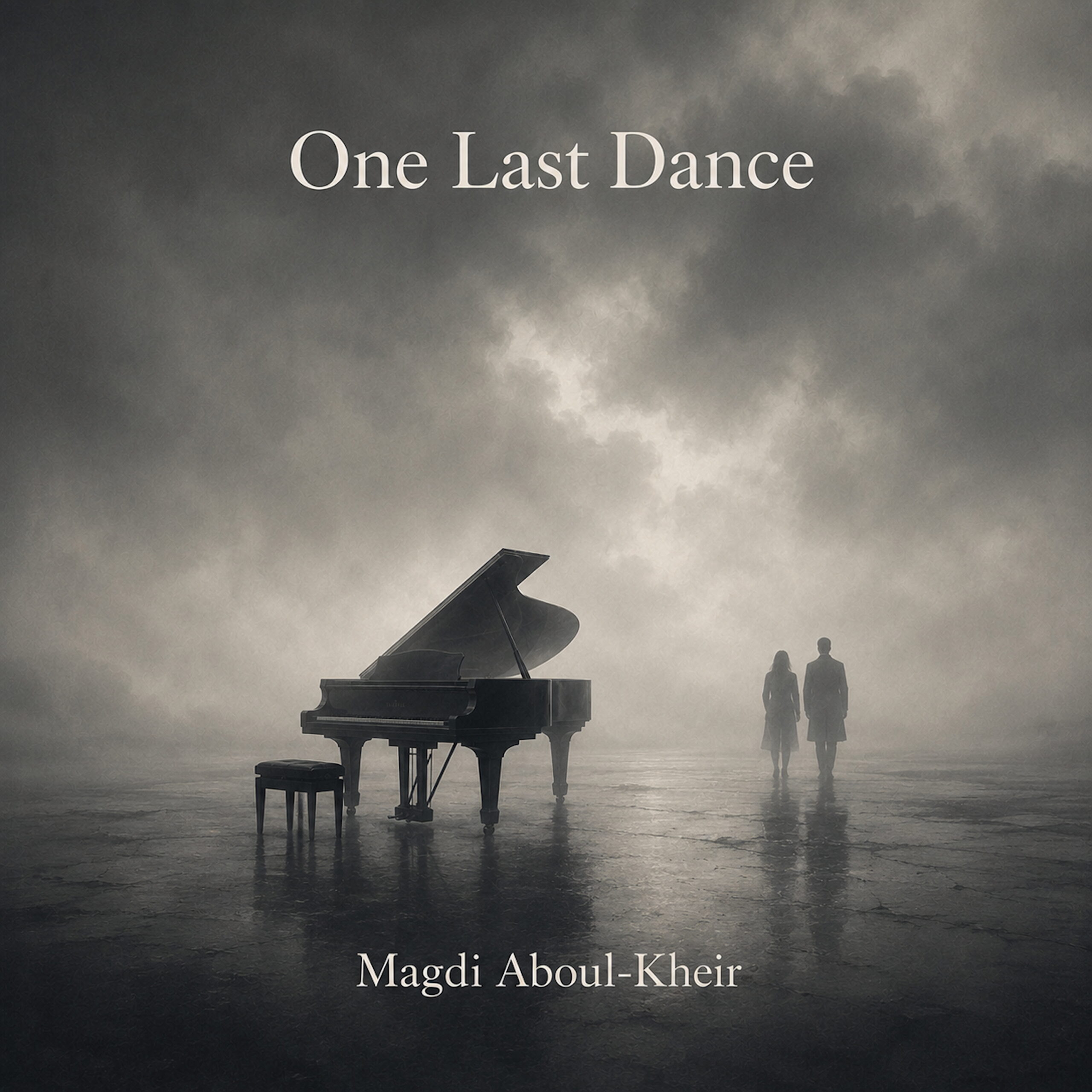
It gives us much pleasure to greet once again the highly talented Magdi Aboul-Kheir among our pages. Residing in Germany, this artist and writer presents himself as the ultimate sonic alchemist, who effortlessly manages to cross that very line which divides the rigorous and elaborate architecture of Baroque from the wild and unrestrained spirit of heavy metal. Seeing him at work means watching a performer who does not limit himself by a particular genre and whose pieces can be just as impressive both in the quiet context of a string quartet and in the pulsating environment of a trance hall. Although his background is well-established within the demanding realm of traditional piano instruction, Aboul-Kheir is no ordinary pianist. He is, at heart, a composer driven by an unwavering passion for melody, an authentic romantic in the contemporary world. It is impossible to ignore the magic that he creates; he creates undeniably enchanting sounds, be it when using the lavish and wide-ranging colors of a symphony orchestra or drawing out the warmth and nostalgia from the electronics of an old synthesizer. We have followed him all the way he has come to – from the intense buildup of “Slow Heat,” and the storytelling of “The Weaving Of Human Nature” to the dream-like state of “The Piano Has Been Dreaming.” He has now graced us with another musical piece, his most recent one, which is called “One Last Dance.” Released on June 26th, this music piece deserves all the attention we can give it. So let’s get started.
Finding such an artist whose integrity and vision are never compromised is a very rare occurrence, yet the trust placed in Magdi Aboul-Kheir has never disappointed me. Being in constant contact with the artist, being influenced by his music, I have come beyond being an ordinary viewer of his art; I am now completely absorbed in the art of the composer, his fan for sure. Once you enter the world that he creates, there is no way out; it is just a paradise of pure artistry. All of you are invited to come over to this side of the fence, where music is always lush, where creativity is abundant, and where the reward for your ears is honey indeed. Let’s dance together!
The piece begins not with a flourish, but with a tentative, isolated note that rings out into a vast, silent space, as if the composer is testing the resonance of a long-abandoned ballroom floor. It immediately establishes a sense of gravity, slowly layering hushed, lower-register chords that feel like the rhythmic pulse of a heart settling into a deep state of contemplation. As the listener traverses “From Depth to Depth”, it seemingly reveals itself as the excavation of the soul; it explores the way we dive into our own histories to find meaning, moving through the layers of who we were to understand who we are becoming. Musically, the performance is profoundly intimate, utilizing the mechanics of the piano, the felt dampers, the subtle creak of the bench, and the soft strike of the keys to pull the listener into a private sphere. There is a weightiness to the left-hand accompaniment that provides a sturdy, grounding foundation, while the right hand traces fragile, searching melodies. The impact is restorative, forcing the listener to align with the deliberate, unhurried cadence of the music, effectively stripping away the noise of the outside world.
This piece begins with an arpeggio in the higher register that represents the movement of spinning motion, as a symbol of the beginning of a memory that cannot be stationary. As we enter the “Carousel of the Mind”, the music transforms from its delicate beginning to something more flowing and spacious, where it explores how our minds revisit the moments of joy and regret equally. This piece deals with the concept of constant human thought, the way our consciousness goes back and forth, playing out the different scenarios and emotional situations, and always thinking about the same things in slightly varied ways. The music is very complex, with the piano changing from sparkling arpeggios to meditative clusters that show us how memories keep coming back to our minds in different forms. It seems as if we are observing from a platform how time passes in patterns, how the notes cross and connect to give the music its momentum and fluidity.
“Veil Of Fog” begins with an airy, indistinct chord progression that, through its intentional ambiguity, gives the feeling of gazing out of a window at the landscape of a foggy morning where the horizon has disappeared under layers of mist. With the Veil of Fog falling, the music takes its theme and focuses on ambiguity, transition, and the subtle beauty in not knowing what is next. In terms of musicality, the use of pedal techniques creates a harmony wash, which can only be described as the equivalent of an impressionistic painting. Melodically speaking, the piece has a vocal-like nature, and it feels as if the piano itself is singing in a melancholic lullaby that attempts to break through the surrounding mist. Effectively, the listener becomes suspended in a state of serenity, in a rare instance where there is no need for clarity and solutions because of the mystery involved.
The piece begins with an incredibly delicate hit of the piano strings in what seems to be a very soft inhale before the beginning of the main melodic phrase. It is an inviting introduction that sets the mood of safety and artistic inspiration right from the start. In the composition “Calliope’s Embrace,” the idea revolves around the muse- that moment of transcendence when everything around becomes unimportant and inspiration arises. It embodies that state when one is wrapped up in passion, an intimate connection to one’s inner artist. Musically, the composition is light and flowing, with the melody gracefully hovering above a steady rhythm of low notes that seem to provide a constant beat. The voicing is crystal clear yet delicate, with the notes slowly fading into nothingness, thus evoking the desire to immerse oneself in one’s own inspirations and joy.
The piece opens with an immediate contrast, a strong and ringing bass note immediately followed by a gentle and melodic harmonic chime. Throughout “Two Sides of Tomorrow”, the topic is one of conflict and the struggle between the worries that plague us for the future and all the opportunities that await us. In terms of music, Aboul-Kheir makes use of the full extent of the piano keys, moving from dark, powerful chords which convey the weight of uncertainty to light and melodic runs which convey the ephemeral optimism of what might come. The piece itself is quite dynamic, growing louder in the stronger parts and falling silent between them in a nearly breathless fashion. To the listener, it is as though this piece were written in their own reflection and conveys the exact feeling of standing at the point of change and feeling drawn by the unknown.
The piece begins with a slow rhythmic pulse, which sounds like rain hitting a window of glass, eventually merging into a solid chord that sounds like nothing but an exhale. Through A “Quiet Yes”, the central idea is that of surrender – not the act of giving up but rather that of accepting and yielding to something to achieve a state of peace. This is the sound of finally being at one with one’s life as it is. As far as instrumentation is concerned, there is only the natural movement of the fingers, which results in a very intimate and mellow performance. There is a great simplicity in the way the melody is resolved, as if the composer chooses each note with the intention of making it decisive and peaceful.
The introduction is marked by a lively rhythm that evokes feelings of the first rays of sunshine breaking into a dark room, implying the instant change of mood through the use of bright major tonalities. “When smiles return,” listeners get to go through an entire tutorial on how to recover from their emotions, thereby reflecting the topic of resilience and a slow, fragile return of happiness following a difficult period in life. In the piano play, there are many fast and light-hearted trills and runs up the scale, which reflect the lifting of the burden. Overall, the musical texture is bright and full of percussion sounds, giving listeners a feeling that the mist has finally cleared up.
The song starts with a slow, atmospheric movement of sound, made possible by sustaining the sustain pedal for longer periods, which makes the harmonics of the strings bleed into each other, creating an ethereal and magical texture. “Enchanted by your light,” the song’s theme reflects the magic that another individual or possibly an enlightening experience can bring into the dark parts of life. It is an elegant and sincere song, reflecting the beauty of being enchanted by a warm and magical thing or an event. As for its musical characteristics, the melody is melodic and broad, performed in a rubato that is very sincere and conversational, as if the piano whispers something special. In terms of instruments, the chords used have bigger voicing, creating a sense of great open space and referring to those who inspire us and help us get through life.
The title track, “One Last Dance”, opens up with a slow, sad waltz, with the rhythm resembling that of an old floorboard under someone’s cautious step, instantly setting the tone. The message of the song is a nostalgic and emotional goodbye to the past, and all that happened there, paying respect to it once more, just before letting it go. The music of the song is very thought out, with a strong focus on the relationship between the nostalgic, circular bass line and melody. The musical style and the instruments used in the song are authentic, giving the listener an experience of listening to the piano with its mechanics fully exposed and the feeling of a lingering and final dance with someone beloved.
The album ends on a series of light, descending notes that come across as the settling of dust particles or a heavily weighted door slowly being shut. At this point, in “Afterthoughts”, the theme is reflection: the quiet, slow moments after a powerful experience that allow us to start making sense of what we have just gone through. It is about putting away our memories and allowing the teachings of the album to seep down to our bones. In terms of the music itself, there are no frills in this song; all extraneous notes are stripped away to leave only the essential ones. The performance is methodical and soothing, with the slow pace giving time for the listener to absorb the full emotional impact of everything that has just happened.
Finding such an artist whose integrity and vision are never compromised is a very rare occurrence, yet the trust placed in Magdi Aboul-Kheir has never disappointed me. Being in constant contact with the artist, being influenced by his music, I have come beyond being an ordinary viewer of his art; I am now completely absorbed in the art of the composer, his fan for sure. Once you enter the world that he creates, there is no way out; it is just a paradise of pure artistry. All of you are invited to come over to this side of the fence, where music is always lush, where creativity is abundant, and where the reward for your ears is honey indeed. Let’s dance together!
Stream the “One Last Dance” album on Spotify.
Follow Magdi Aboul-Kheir on his socials: Facebook, Instagram, Bandcamp

- “MAYBE LOVE’S A CRIME”: DOWNTOWN MYSTIC DELIVERS A ROCK ‘N’ ROLL MASTERCLASS - 14 October 2026
- “WHY ?” BY JFK BLUE: A MASTERCLASS IN SOULFUL BLUES ROCK AND HEARTBREAK - 14 October 2026
- POPKANON RARRIQUESO, JACK FLASH GIVES US “MORE TO GIVE” IN A JAW-DROPPING MASTERPIECE OF SCANDINAVIAN-CHICAGO SYNERGY - 9 October 2026