
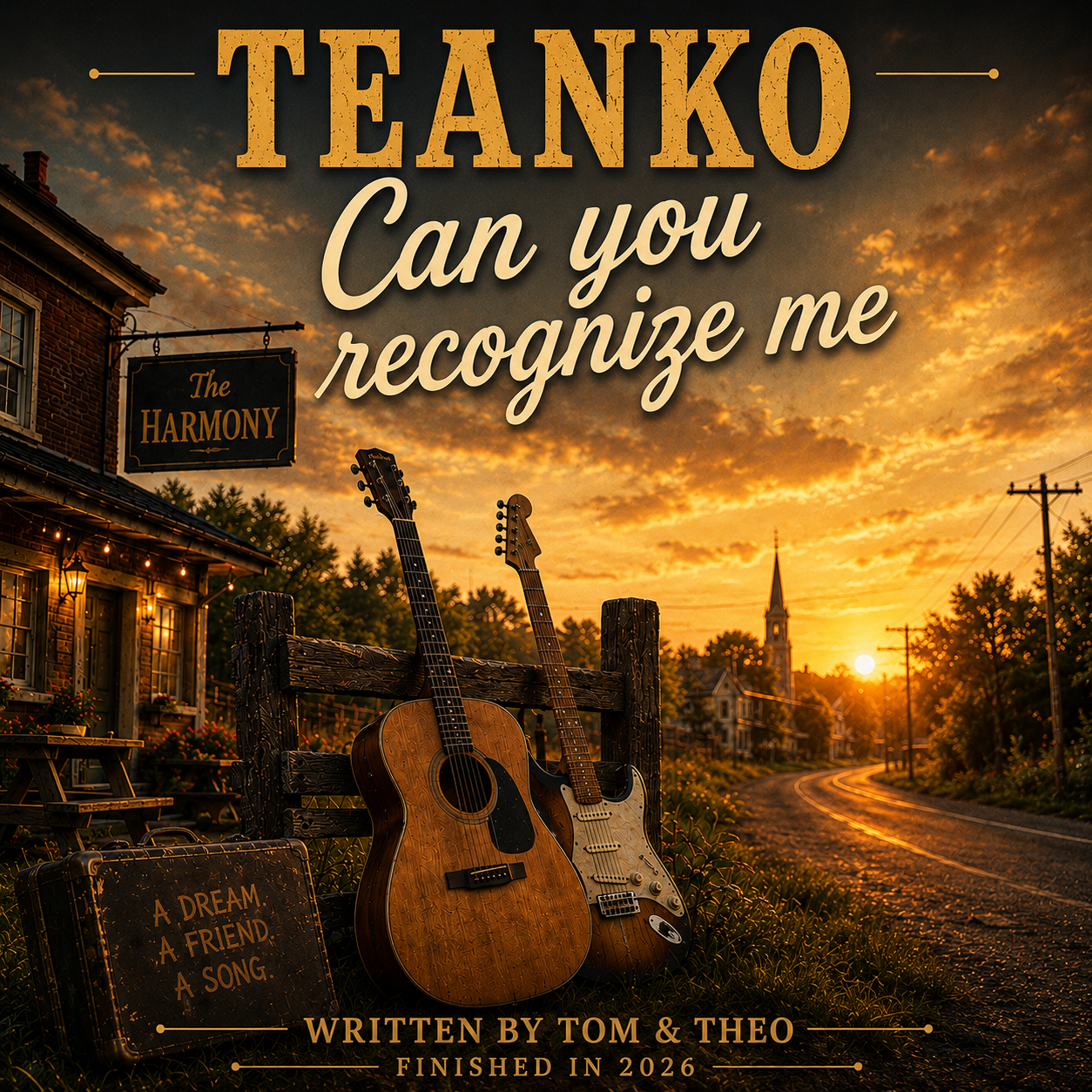
If an artist has been making lightning out of analog air for well over half a century of calendar loops, with a family tree stretching back through years of playground practice sessions and an 18-year-old introduction by fire in a professional studio, then hearing the drop, ‘Can You Recognize Me,’ released on September 3rd by TEANKO, is like witnessing him place a hand on a bronze bust he made himself. Through the lens of his Portuguese sky, Dutch director Theo Konst chases no relevance. Half a lifetime of living, breathing, and bleeding through either desk or microphone has left its mark, a quiet and profound mark of experience that makes five decades seem like nothing but warm-up laps. ‘Can You Recognize Me’ is not merely the name of a track, but an image being cast into the mirror of everyone blessed enough to tune into the wavelength of an artist who never stopped bleeding on tape. Let’s pull back the curtains. Let’s talk about the masterpiece.
Not only does the introduction guitar riff of this piece welcome you, but it sets ablaze in an otherwise quiet environment—soft, amber-tinted, and pulsing with life beneath fingers that know every nuance of the guitar fretboard. Theo takes the microphone after that and serves the aural version of slowly pouring a thirty-year-old single malt—buttery smooth, as suave as midnight whiskey, and colored by the mahogany tones only earned by half a century of telling nothing but the truth. It’s a velvet-knotted warning shot. From the first syllable, you are not only hearing a song; you are knee-deep in a lesson, with a profound mark of experience that makes five decades feel like the architect of it all, quietly reminding everyone of who owns the blueprints.
Now let’s talk about the inspiration and theme of the song. Describing ‘Can You Recognize Me’ as “a delayed homecoming” would be an utter injustice to the magnitude that Theo Konst accomplishes through the song. It is not only a song but a time capsule found in the moist soil of Oosterblokker after being buried fifty winters ago by the thumbprint of a young boy. Before the days of digital production, Portuguese horizons, and modern technology, there existed Blokker – the flatlands Dutch postcard, the place whose heart beat to the rhythm of Cafe De Harmonie and where an old guardian-tree of the church watched its creation with eyes made of stone. It was right then, in the makeshift classroom attached to the rough timbered schoolhouse that the boys dubbed “the veranda,” when little Theo, along with his alter ego Tom, lit the match, creating the beginning of a chord progression destined to lose a limb, a future no seventeen-year-old should ever have to endure. When the pages closed on Tom’s life story, the song became frozen in time, an incomplete sentence floating in the air of a broken timeline. It is typical for humans to keep their ghost in the attic. But not Theo Konst. He spent over fifty years earning his gray hairs, his calloused experience, and the keys to the castle. But when he asks, “Can you recognize me, after all these years?” there’s no reflection bouncing off a dry wall, but rather tunneling through the roof of time. What elevates this work beyond the mundane is its dexterity at being a double agent of destiny. It takes the cobbled streets of Oosterblokker, the glow of Harmonie, and the silent witness of the tree in the churchyard as nothing more than coordinates on an entirely larger map. And in the ultimate conclusion of the song, it doesn’t look in the rearview mirror, but over the edge of the world, to the final call. As soon as the lyrics land, “They called me to come home / So here I am again / If you’re still making music / We’ll try again”, the room falls away. Ego death and artistic immortality in a warm whiskey-and-steel production. Just one who knows his stuff from the inside out, like Theo Konst, who, having had fifty years’ worth of blood vessel stories and the unusual battered purity of still believing that children’s vows will hold even in death, could take a tragedy and make it a rehearsal for paradise. Tom’s guitar case may have been closed for fifty years, but the amplifiers are heating up now.
And let’s not forget the mechanics of this miracle of ghost-dancing, for Theo Konst, the lifer in question, does not look into the future with cracked fingers; he strangles it and forces it to do the beat. While one half of the contemporary world is treating development of studio technique as a panic room, Theo has experienced each of its tectonic shifts personally, starting from the friction of warm grease on analog tape and ending with the present day’s bleeding edge of artificial intelligence. It’s time to set the record straight for the masses: For TEANKO, artificial intelligence is not some ghostwriter snatching the reins from him; it is just another copper wire in a cathedral that has been consecrated by fifty years of sweat. These current-day vocal samples are not some sort of artificial copy created out of thin air; they are created only from his own personal archive of blood-warm recordings taken from endless hours of recordings done on his beloved Neumann U67. Each individual note and sound is picked, sculpted, and meticulously produced by the very same human artist that first began striking chords on a Blokker porch five decades ago.
Why don’t we call it what it really is? Not some kind of song played for three minutes on the clock, but a headstone of acoustics cut out of fifty wasted years? Here is the precious architecture of brotherhood, an experience in which two boys play riffs with each other in the night on a wooden veranda in Oosterblokker, until the gods decide to close the door on one of the boys and give all of the work to the surviving boy through fifty years of changes. Listening to this sacred geometry behind the scenes of Theo and the everlasting Tom is no ordinary listening. You are not looking at the memorial from afar and from beyond velvet ropes; you are inside a room full of the buzz of teenage ambition and fifty years of dedication that would not let itself be buried in the soil. The infinite reverence, a standing ovation that reverberates through the roof, and a permanent front-row seat in anticipation of whatever sacred relic Theo will conjure from the air next time. Maestro, you did more than complete an unfinished demo. You completely changed the grammar of grief. Run it straight into eternity.
Stream “Can You Recognize Me” on Spotify
Subscribe to Teanko’s YouTube

- “POPULATION YOU AND ME”: MARC CRUISE’S TRIUMPH OF RESILIENCE AND RECLAIMED SOUND - 20 September 2026
- SOARING ABOVE THE CRUCIBLE: WHY TANIÁ KYLLIKKI’S ‘HUMAN’ PROVES HER DIVINE VOCAL POWER IS AN UNSTOPPABLE FORCE OF NATURE - 20 September 2026
- FIFTY YEARS ON THE VERANDA: WHY TEANKO’S ‘CAN YOU RECOGNIZE ME’ PROVES LEGACY IS A BLOOD-WARM DUET ACROSS THE VEIL - 20 September 2026
