
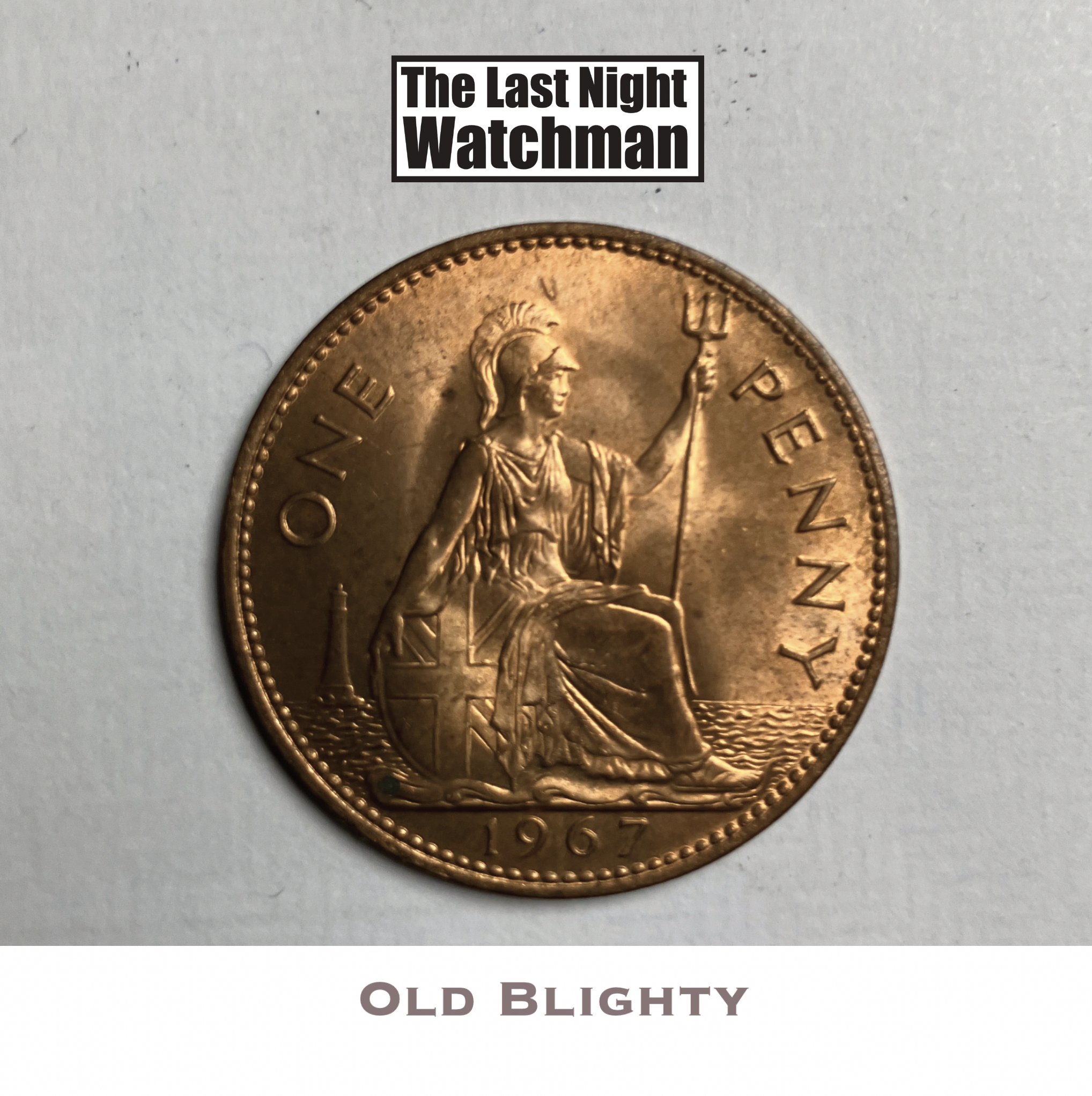
Behind the curtains, making some space for Last Night Watchman, an absolutely visionary person who has been working hard to produce one of the best sounds around without much of the fanfare and fuss. Although this amazing EP serves as a purely individualistic project for our man, he is helped in this mission by a very famous creative partnership in which there is my old friend John Horton, widely known as the brilliant Sven Vortex. For all those people who recall the good old times of Birmingham’s indie underground scene, John and our artist have been the two-guitar backbone of the Noseflutes – a legendary group whose contribution includes memorable BBC sessions and great EPs/LPs. The eighth of September saw the culmination of such a glorious past in a powerful and evocative EP, “Old Blighty”. There is nothing more thrilling than revealing the layers of this wonderful EP to you.
A clear and warm guitar melody that welcomes you so softly. The song “Old Blighty” utilizes this tense and atmospheric build-up as a means to embark upon an uncompromising exploration of issues surrounding national identity, colonial power, colonial past, and British patriotism with its accompanying mythology, all of which were greatly influenced by the destruction of historical monuments in cities around the world. With its lyrics, it addresses the dichotomy of loving a country even while having to come to terms with the grim history that it entails. The musical elements of the song consist of a dirty blend of alternative folk and brooding indie rock, with its prominent feature being the powerful, crashing acoustic rhythms that are juxtaposed with John Horton’s tortured and weeping electric guitar solos and the ambient sounds of the keyboard. The vocal delivery is worn and colloquial, speaking from the perspective of a long-time observer; however, it blossoms into a dramatic choir-like arrangement of layered vocal takes when the chorus arrives. In essence, the song makes the listener reflect deeply, creating an eerie heaviness that pushes the listener beyond patriotism towards heritage.
Fading out from the influence of geopolitics of the modern age and entering the silence of deep geological time, “Footprints” begins with a delicate, high-frequency beat and acoustic bass and guitar melody, with individual notes falling slowly like raindrops in an empty room, accompanied by the subtle, cinematic ambient sound of a bass hum. The lyrical content takes a surprising detour to the distant past and borrows its inspiration from the incredible discovery of human footprints, fossilised footprints dating back almost a million years, preserved in soft mud, and uses this remarkable discovery as a vehicle for looking at the contrast between human transience and the eternity of Earth’s clock. Regarding the musical aspects of the song, the instrumentation is characterized by minimalistic and hypnotic elements where delicate acoustic picking and soft orchestral pads are used, creating a feeling of spaciousness. The vocals are delivered in an incredibly quiet manner, almost whispering, since the singer seems afraid of waking up the old history being told by him. In this way, the song offers an out-of-body experience of meditation and makes people realize their insignificance on Earth.
From the distant past straight into the precarious clock ticking away of human existence today, “Get The Best Out Of Life” opens itself up to a lively and percussive strumming of an acoustic guitar, which quickly receives accompaniment from a lively sound and the joyful tapping of foot-stomping percussion beats. This song’s fundamental theme is one of desperate resilience, mortality, and joyfulness, built on the fires of individual sorrow and awareness of how rapidly time passes. The lyrics are not focused on simplistic optimism but rather are found in everyday life’s small mercies and remind us to be alive and not allow ourselves to be ruled by despair. After the artist’s father died, he was clearing his bookshelves and came across a Reader’s Digest compendium from the mid 1950s titled ‘Getting The Best Out of Life’, full of essays on self-improvement. That became the inspiration for this song. It’s lovely to know the inspiration for the song and the personal connection that it has with the artist. In terms of music, this song acts as the bright and emotive heartbeat of the entire EP, characterized by the fluid use of folk-pop instrumentation that includes natural guitar melodies and acoustic components, all moving towards a positive pace. The singing is warm, natural, and very inspirational, having a touch of everyday friendliness in the form of life advice one would get from a friend over beer. It makes the audience feel like the climate changed right in front of their eyes, inspiring them to stand up straight and call people they care about.
Returning to the shadows for a period of soul-searching, “Fool’s Prayer” opens with an ominous and slow progression of muted electric guitar chords, ringing out with the gravity of leaden footsteps and complemented by a wailing synthesizer drone. The song lyrics themselves explore themes of human arrogance, personal failings, and the silent desperation for redemption in a world that seems indifferent to our moral foibles. The song talks about how it’s a bad thing to witness someone you know suddenly losing their religion. It acts as a contemporary psalm about the struggle between our noble intentions and our fallen nature. In terms of music, the instrumentation is spare, brutal, and soaked with a moody atmosphere, achieved through the use of sustained atmospheres, weeping electric guitar countermelodies, and a lumbering, deliberate rhythm section that captures the heaviness of a guilty conscience. The singing voice is stripped to its core, tremulous, almost about to break, deliberately pitched low to show every imperfection. The result is a powerful emotional effect on the listener, one that inspires an immense amount of shared human empathy and a private, uncomfortable self-examination.
“Towards The Sun,” as the grand finale of the EP, begins with a sparkling shower of plucking notes on the acoustic guitar and slowly growing keyboard chords that seem to emerge slowly and majestically upwards from beneath a dark and jagged horizon line of night into morning light. The downside to being online most of the time is that it’s easy to forget there’s a real world beyond your front door. The song reminds us to take a break from looking at our screens and actually go outside and break ourselves free from technological barriers. This song is the equivalent of people telling us to put our screens away and touch grass. From a musical perspective, this is by far the most sprawling and elaborate piece on the album, with John Horton’s uplifting guitar sounds working in harmony with orchestral swells and a huge vocal build-up that saturates every bit of the sound spectrum. There is an uplifting quality to the singing that is both triumphant and full of emotion. The effect is stunning and utterly peaceful, as if hanging suspended in time while the last echoing sounds disappear.
This realization is what makes the EP a real masterpiece, because when the world around you changes, and you remember all those who are already gone, your music ceases to be concerned with anything else other than the essence of what you do, and Last Night Watchman successfully captured exactly that process in his songs. Old Blighty is not just an album with songs on it, but a true lesson of graceful aging, when loss and contemplation are transformed into pure gold. This is the message conveyed through the melody in every song on this album, and let me tell you that listening to the artist who is willing to put all of his experience and talent into the music he creates is simply amazing.
Stream the “Old Blighty” EP on SoundCloud
Follow Last Night Watchman here and on their socials: YouTube, Bandcamp

- “WASTED TEARS”: RICHARD GREEN DELIVERS AN UNTOUCHABLE INDIE-ELECTRONIC MASTERPIECE - 21 October 2026
- PRESS ON TO PROGRESS: HOW KAHMENCENTS AND CAZPERRBEATS TURNED LIFE’S WEIGHT INTO AN UNSTOPPABLE MOTIVATIONAL ANTHEM “PRESS SURE” - 21 October 2026
- WAKING UP TO GREATNESS: WHY JAMIE’S ELECTRIFYING NEW SINGLE “WAKING UP”,IS A POP-EDM MASTERPIECE - 21 October 2026
